Building Rapport
Building Rapport - The Shortcut to Stronger Connections
Welcome back to another edition of Next-Level Skills. Each edition, we explore the human and leadership capabilities that help us navigate work and life more effectively. Skills that move beyond theory and into practical application.
A warm welcome to everyone who has joined our community since the last edition. Whether you've been with us since the beginning or have recently discovered the newsletter or the book, thank you for being part of this journey.
This week, we’re exploring a skill that’s often misunderstood as surface-level but is, in fact, foundational to trust, influence, and collaboration: Building Rapport.
It’s the art of being relatable without being rehearsed and the ability to create connection before needing cooperation.X
The Unexpected Bond That Closed the Deal
Years ago, during a high-stakes vendor negotiation, we were finalising a major contract. The discussion was tense, transactional, and on the verge of falling through. Then, something simple shifted the tone
One of our senior team members noticed a cricket bat in the vendor’s office background during a virtual call. He casually asked, “Club level or backyard legend?” The vendor laughed, replied “Both,” and suddenly the mood softened.
We spent the next five minutes talking about sport, growing up in regional towns, and childhood heroes. The conversation returned to business, but with new energy. We found common ground. The deal was signed the next day.
Why Building Rapport Is Strategic, Not Social
We often underestimate rapport as a "nice-to-have" rather than a professional differentiator. But rapport is the currency of influence. It lowers resistance, accelerates trust, and makes collaboration more fluid.
When dealing with people, remember you are not dealing with creatures of logic, but with creatures of emotion.
— Dale Carnegie
Whether leading teams, managing clients, or aligning stakeholders - building rapport helps us meet people where they are, not just where we need them to be.
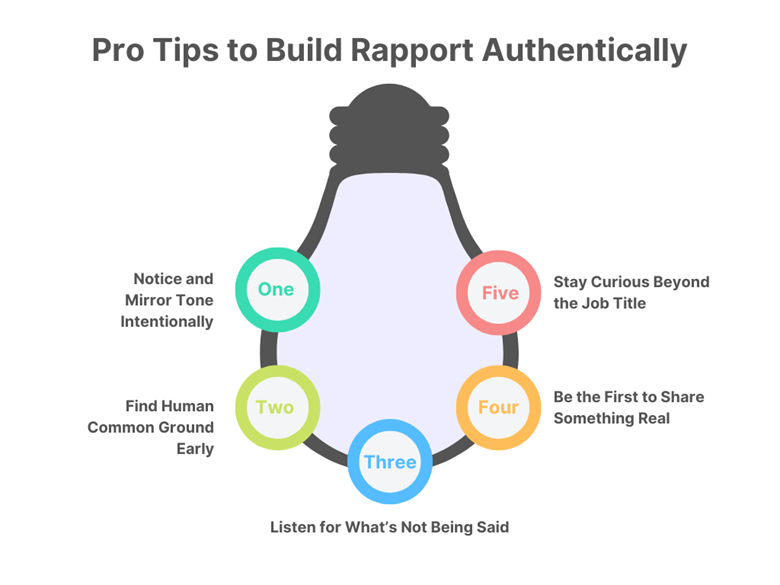
1. Notice and Mirror Tone Intentionally
Pro Tip: Pay attention to how others speak - their tone, pace, and choice of words - and subtly mirror it. It creates subconscious alignment and comfort.
2. Find Human Common Ground Early
Pro Tip: Begin conversations with a question that invites shared human experience - like a comment about the setting, a compliment, or curiosity about their role.
3. Listen for What’s Not Being Said
Pro Tip: True rapport comes from active listening. Watch for tone shifts, hesitations, and facial cues. Reflect back what we sense, not just what we hear.
4. Be the First to Share Something Real
Pro Tip: Vulnerability builds bridges. Share a small personal anecdote, challenge, or even a mistake. It signals that the space is safe for authenticity.
5. Stay Curious Beyond the Job Title
Pro Tip: People remember how we made them feel, not just what we discussed. Ask what excites them about their work, or what they’d change if they could.
This and other essential skills are covered in Next-Level Skills — the book.
Learn more about the Book →A Challenge
Try these small but powerful actions this week:
Reflection Questions
Some Final Thoughts...
Building rapport isn’t about charm or charisma. It’s about presence, empathy, and intention. When we make others feel seen and heard, we open the door to trust, creativity, and collaboration.
People will forget what we said, forget what we did, but never forget how we made them feel.
— Maya Angelou
Let’s practise making others feel valued, because relationships are the foundation of everything that matters at work.
Until Next Time,
Abhishek
Founder & CEO, LegiQ | Building Intelligent Edge Hardware
Do we treat rapport-building as strategic or incidental in our leadership?
Are we focusing more on information or connection when we meet new people?
When was the last time we built rapport with someone that helped move a conversation forward?
How would our relationships shift if we focused 10 percent more on curiosity?
When rapport is missing, what’s usually the barrier - time, trust, or technique?
What role does humour or storytelling play in how we build relationships?
Have we been mirroring others’ tone and pace, or pushing our own style first?
How do we respond when someone shares something vulnerable - do we reciprocate?
What’s one question we could ask this week to spark a deeper conversation?
What does it take for someone to feel seen by us during a meeting?
Buy the Book
- ✓Learn the full Next-Level Skills framework.
- ✓Build clarity, influence, and decision-making strength.
- ✓Accelerate your personal and professional growth.
This and other essential skills are covered in Next-Level Skills — the book.
Learn more about the Book →This edition is reserved for supporters
Subscribe free, then unlock every past edition with just 1 successful referral.
Subscribe Free →Enjoyed this edition?
Get the next one in your inbox — first week of every month.