Managing Ambiguity
Navigating the Fog : The Skill of Managing Ambiguity
Welcome back to another edition of Next-Level Skills. Each edition, we explore the human and leadership capabilities that help us navigate work and life more effectively. Skills that move beyond theory and into practical application.
A warm welcome to everyone who has joined our community since the last edition. Whether you've been with us since the beginning or have recently discovered the newsletter or the book, thank you for being part of this journey.
This week, we tackle one of the most underrated yet essential skills in today’s world of flux: Managing Ambiguity.
In environments with shifting priorities, unclear roles, and unpredictable outcomes, ambiguity isn’t a glitch. It’s the new normal. And our ability to work within it is what sets us apart.
The Strategy Deck Without a Title
During a leadership offsite a few years ago, I was tasked with presenting a strategy recommendation to a cross-functional executive group.
The catch?
The brief was minimal. Stakeholder goals conflicted. Data was incomplete. No one was quite sure what the decision should even be.
I remember staring at a half-empty deck the night before and thinking, “What am I even solving for?”
But instead of filling in blanks with assumptions, I built a structure around questions. I presented not answers, but scenarios. I framed the risks. I acknowledged the grey. And surprisingly, the meeting unlocked more clarity than any decision memo would have.
Why Managing Ambiguity is a Superpower
Ambiguity is everywhere - in job roles, in cross-functional work, in strategic decisions, in communication. When we freeze, avoid, or over-control uncertainty, we shrink. But when we navigate it with calm, curiosity, and structure, we earn trust.
Only the paranoid survive.
— Andy Grove
But in today’s context, it’s not paranoia that wins. It’s perspective. It’s our ability to stay engaged even when we don’t have all the answers.
Let’s explore how to cultivate ambiguity-resilience in practical ways.
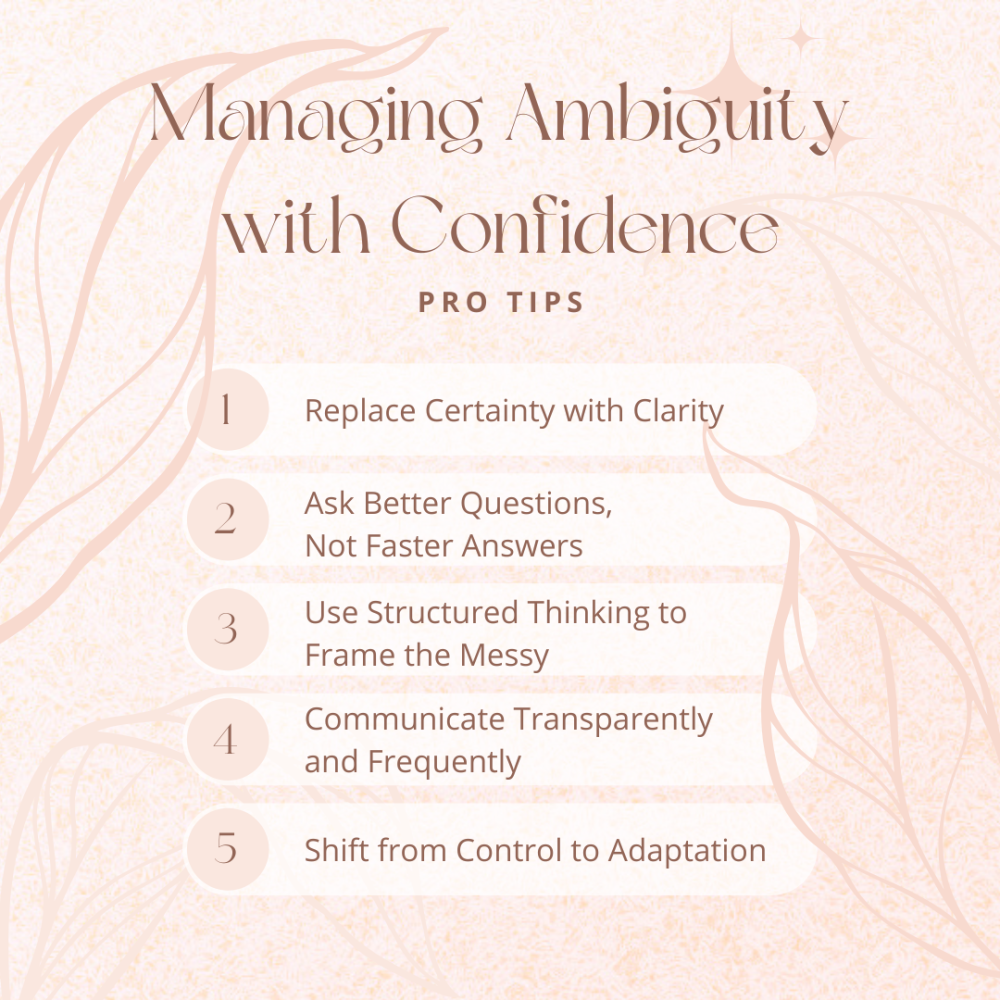
1. Replace Certainty with Clarity
Pro Tip: Instead of forcing decisions prematurely, frame what's known, what's unknown, and what assumptions we’re working with.
2. Ask Better Questions, Not Faster Answers
Pro Tip: Shift from solution mode to exploration mode. Ask, “What’s the real problem we’re solving?” or “What would success look like across scenarios?”
3. Use Structured Thinking to Frame the Messy
Pro Tip: Tools like decision trees, impact-effort grids, and hypothesis maps give shape to uncertainty. They reduce overwhelm by visualising complexity.
4. Communicate Transparently and Frequently
Pro Tip: In ambiguous situations, silence fuels anxiety. Share updates - even when progress is messy or slow. Narrate the thinking, not just the results.
5. Shift from Control to Adaptation
Pro Tip: Let go of needing to know everything before acting.
Pilot. Test. Adjust.
Build feedback loops into our decision-making rhythm.
This and other essential skills are covered in Next-Level Skills — the book.
Learn more about the Book →A Challenge
Here are a few small steps to start building comfort with ambiguity:
Reflection Questions
Some Final Thoughts...
Managing ambiguity is not about eliminating uncertainty. It’s about increasing our tolerance for it. When we bring structure to confusion, calm to complexity, and curiosity to unclear situations - we lead from a place of strength.
The most important thing in communication is hearing what isn’t said.
— Peter Drucker
The same applies to strategy, leadership, and everyday choices. What’s not said is where the real opportunity lies.
Let’s learn to lead in the grey - not just the black and white! What do you say?
Until Next Time,
Abhishek
Founder & CEO, LegiQ | Building Intelligent Edge Hardware
What’s one situation where embracing ambiguity led to a better outcome?
Do we communicate uncertainty with transparency or hide it?
What’s one risk we’re avoiding just because the path isn’t fully clear?
What tools or frameworks help us make sense of messy problems?
How can we help our teams feel more confident in ambiguous moments?
How do we typically respond when faced with unclear expectations?
Where in our work do we most often encounter ambiguity?
Are we comfortable making progress without perfect information?
How can we better separate assumptions from facts in decision-making?
If we reframe ambiguity as a creative advantage, how would our actions shift?
Buy the Book
- ✓Learn the full Next-Level Skills framework.
- ✓Build clarity, influence, and decision-making strength.
- ✓Accelerate your personal and professional growth.
This and other essential skills are covered in Next-Level Skills — the book.
Learn more about the Book →This edition is reserved for supporters
Subscribe free, then unlock every past edition with just 1 successful referral.
Subscribe Free →Enjoyed this edition?
Get the next one in your inbox — first week of every month.