Fail Faster
Fail Faster to Succeed Sooner
Welcome back to another edition of Next-Level Skills. Each edition, we explore the human and leadership capabilities that help us navigate work and life more effectively. Skills that move beyond theory and into practical application.
A warm welcome to everyone who has joined our community since the last edition. Whether you've been with us since the beginning or have recently discovered the newsletter or the book, thank you for being part of this journey.
Today, we’re unpacking a concept that sounds counterintuitive but holds immense power: Fail Faster.
It’s not about being reckless.
It’s about learning quickly, iterating intelligently, and building resilience on the path to success.
The Project That Almost Didn’t Launch
Years ago, during one of my early consulting projects, we spent months perfecting a client solution before ever testing it.
Every detail was polished, every presentation slide immaculate. But when we finally rolled it out, it missed the mark completely. The users didn’t need most of what we’d built.
The problem wasn’t effort or talent - it was fear of failing early. We wanted it flawless before showing anyone, and that perfectionism delayed the most valuable feedback.
That experience shifted my approach forever. I realised that failing early in a controlled way saves time, money, and pride later.
The Power of Learning Loops
In fast-moving industries, the winners are not those who avoid mistakes, but those who learn from them faster. Failure becomes a teacher when we see it as feedback, not finality.
I have not failed. I’ve just found 10,000 ways that won’t work.
— Thomas Edison
Each attempt brought him closer to invention. Similarly, every failed experiment in our projects, products, or ideas carries insight that guides the next move.
When we view setbacks through the lens of iteration rather than defeat, we create momentum. Learning loops - the cycle of testing, reflecting, and improving - become the backbone of innovation.
Reframing Failure: From Fear to Fuel
Failure often triggers our ego. It threatens our competence and confidence.
But when we strip away judgment, failure becomes data. It shows what doesn’t work so we can focus on what does.
Psychologists call this a “growth mindset” - the belief that abilities can be developed through effort and learning. By embracing small, fast failures, we neutralise the fear that holds us back and build the mental agility needed for complex problem-solving.
As we learn to detach our self-worth from outcomes, we gain the freedom to experiment boldly.
That’s where creativity lives - just beyond comfort.
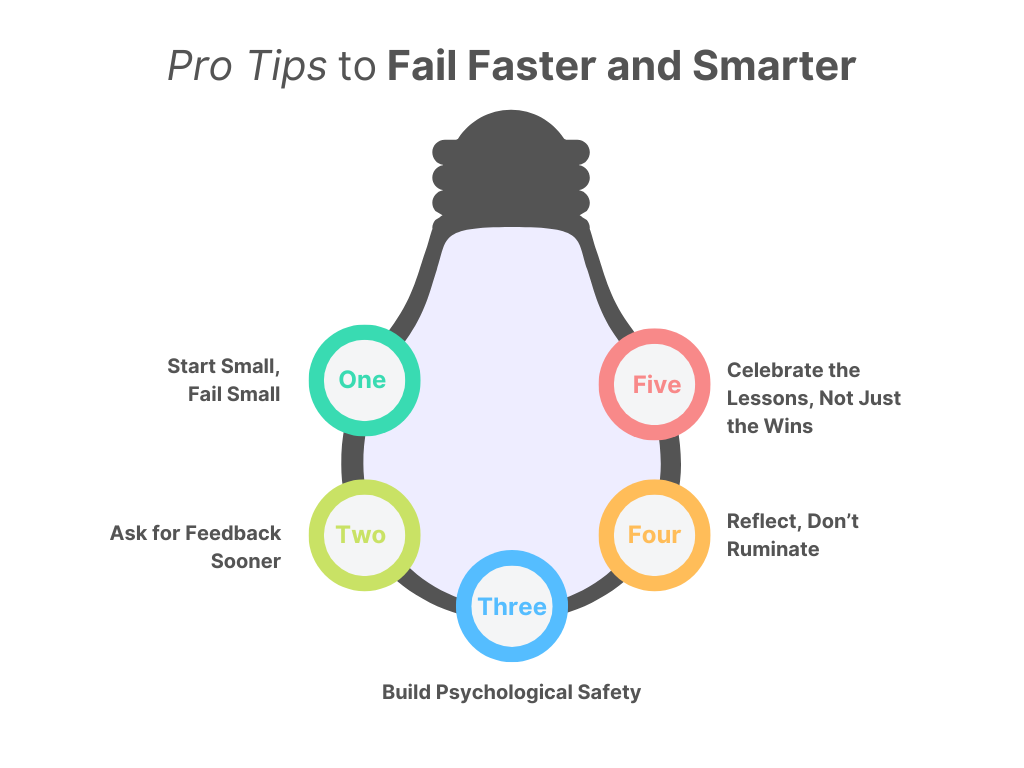
- 1Start Small, Fail SmallProt Tip : The smaller the test, the quicker the feedback, and the lower the cost of failure.
- 2Ask for Feedback SoonerPro Tip: Waiting until things are “ready” delays learning. Seek input while ideas are still rough -that’s when feedback can truly shape direction.
- 3Build Psychological SafetyPro Tip: Teams that feel safe to fail, share, and question learn exponentially faster. Encourage open discussion about what didn’t work and what was learned.
- 4Reflect, Don’t RuminatePro Tip: After every setback, run a brief retrospective: What worked? What didn’t? What’s next? Reflection turns emotion into action.
- 5Celebrate the Lessons, Not Just the WinsPro Tip: Recognise individuals or teams who take intelligent risks. Reward curiosity and resilience - they’re the engines of progress.
Failing Faster in Practice
In agile project environments, “fail fast” is more than a slogan - it’s a system.
Regular sprints, daily stand-ups, and feedback loops exist to reveal problems early. The same principle applies in leadership and personal growth.
When we spot warning signs quickly and act decisively, we reduce damage and accelerate improvement. Failure stops being a full stop and becomes a comma in our story.
This and other essential skills are covered in Next-Level Skills — the book.
Learn more about the Book →A Challenge
This week, take one calculated risk.
Test an idea sooner than feels comfortable. Ask for feedback before it’s perfect.
You might stumble, but what you learn in the process could save months later.
Some Final Thoughts...
Failure isn’t the opposite of success - it’s the path to it.
Every missed shot teaches aim. Every wrong turn sharpens direction.
Failures are finger posts on the road to achievement.
— C.S.Lewis
Let’s embrace them not as setbacks, but as steps forward in our pursuit of mastery.
Now, over to you - what’s one failure that became a turning point in our growth journey?
Until Next Time,
Abhishek
Founder & CEO, LegiQ | Building Intelligent Edge Hardware
What’s one area of work where we’re currently afraid to fail and what might happen if we weren’t?
What role does self-compassion play in learning from mistakes?
How can failure enhance creativity rather than stifle it?
How can “failing faster” improve decision-making speed in complex environments?
What systems can we use to capture lessons learned from small failures?
How do leaders model the right attitude toward failure?
How do we build a team culture where failure feels safe, not shameful?
What’s the difference between failing fast and failing carelessly?
How can we make reflection after failure a consistent habit?
When was the last time an early mistake saved us later?
Apply These Skills
- ✓Put the frameworks into practice this month.
- ✓Use the reflection prompts inside the book.
- ✓Build habits that compound over time.
This and other essential skills are covered in Next-Level Skills — the book.
Learn more about the Book →This edition is reserved for supporters
Subscribe free, then unlock every past edition with just 1 successful referral.
Subscribe Free →Enjoyed this edition?
Get the next one in your inbox — first week of every month.