Time Management
Mastering Time: The Ultimate Competitive Edge
Welcome back to another edition of Next-Level Skills. Each edition, we explore the human and leadership capabilities that help us navigate work and life more effectively. Skills that move beyond theory and into practical application.
A warm welcome to everyone who has joined our community since the last edition. Whether you've been with us since the beginning or have recently discovered the newsletter or the book, thank you for being part of this journey.
This week, we’re tackling a skill that impacts every facet of our professional and personal lives: Time Management. In an age of endless to-do lists and constant distractions, mastering our time is the key to unlocking productivity, balance, and peace of mind.
The Clock That Almost Beat Me
Years ago, I found myself leading two high-stakes projects while onboarding new team members. My calendar was overflowing with back-to-back meetings, and my to-do list seemed to grow faster than I could tick off tasks.
One day, after yet another late night of catching up, I realised something needed to change — and that too immediately! I started tracking my time meticulously, identifying patterns and bottlenecks. To my surprise, I discovered that an hour each day was being lost to unproductive habits — like skimming emails or revisiting completed tasks.
By restructuring my schedule, setting strict priorities, and delegating effectively, I regained control. Within weeks, my productivity soared, and I found space for strategic thinking and even a few early evenings.
What is Time Management?
Time management is the process of planning and exercising control over how we spend our time to maximise efficiency and effectiveness. It’s not about doing everything — it’s about doing the right things.
The key is in not spending time, but in investing it.
— Stephen R. Covey
Why Time Management Matters
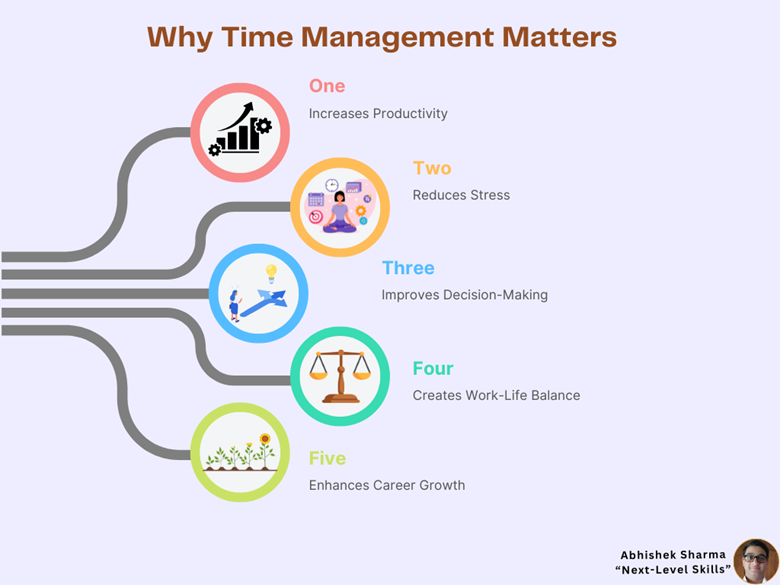
Time management matters because it empowers us to focus on what’s truly important, boosting productivity while reducing stress. It helps us create balance, make better decisions, and ultimately achieve our goals with greater efficiency and clarity.
Effectively managing our time —
- →Increases Productivity: Effective time management helps us accomplish more in less time.
- →Reduces Stress: When we control our time, we avoid last-minute rushes and overwhelm.
- →Improves Decision-Making: Managing our time gives us the mental clarity to make better choices.
- →Creates Work-Life Balance: Allocating time wisely ensures we have space for both professional and personal priorities.
- →Enhances Career Growth: Leaders value individuals who manage time effectively, as it reflects reliability and foresight.
The practical tips outlined in the following sections can guide us towards mastering time management, but first let us look at some of the common challenges we face in effectively managing our most valuable resource — time.
Common Time Management Challenges
Before diving into practical strategies, let’s explore some common challenges that often hinder the effective use of our time.
- →Procrastination: Delaying tasks due to fear, perfectionism, or distraction.
- →Poor Prioritisation: Spending too much time on low-value tasks while critical items are neglected.
- →Multitasking: Dividing attention reduces focus and quality.
- →Interruptions: Emails, notifications, and unplanned meetings disrupt concentration.
- →Underestimating Time: Misjudging how long tasks take leads to missed deadlines.
By understanding the core pillars of effective time management, engaging in honest self-reflection, and continuously adjusting as needed, we can overcome challenges, reshape habits, set clear priorities, meet deadlines, and minimise distractions.
Core Pillars of Time Management
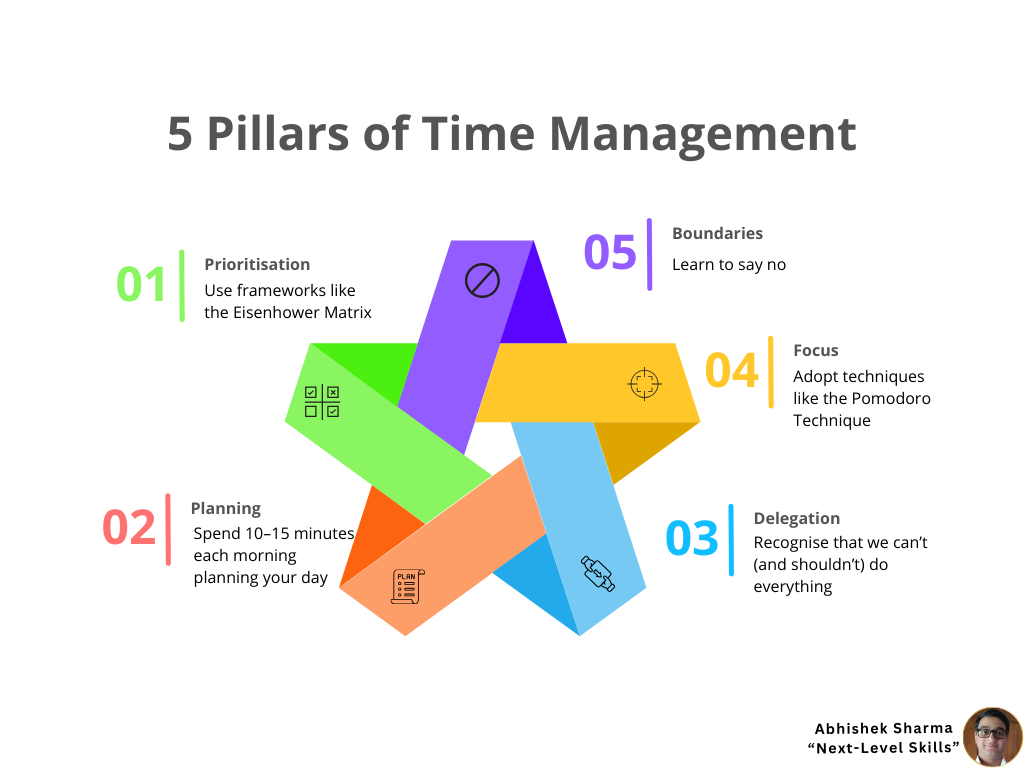
Time management is more than just a productivity tool — it’s a way to bring balance, clarity, and growth into both our professional and personal life. Effective time management is built on five key pillars:
1. Prioritisation
Using frameworks like the Eisenhower Matrix to categorise tasks:
- →Important & Urgent: Do it now.
- →Important but Not Urgent: Schedule it.
- →Not Important but Urgent: Delegate it.
- →Not Important & Not Urgent: Eliminate it.
Things which matter most must never be at the mercy of things which matter least.
— Johann Wolfgang von Goethe
2. Planning
Spending 10–15 minutes each morning planning our day. Identifying our top three priorities and tackle them first.
3. Delegation
Recognising that we can’t (and shouldn’t) do everything. Delegating tasks to capable colleagues frees up time for high-value work.
4. Focus
Adopting techniques like the Pomodoro Technique — working in focused 25-minute intervals followed by short breaks to maintain energy and concentration.
5. Boundaries
Learning to say no when additional tasks threaten to derail our priorities. Protecting our time is essential for sustained productivity.
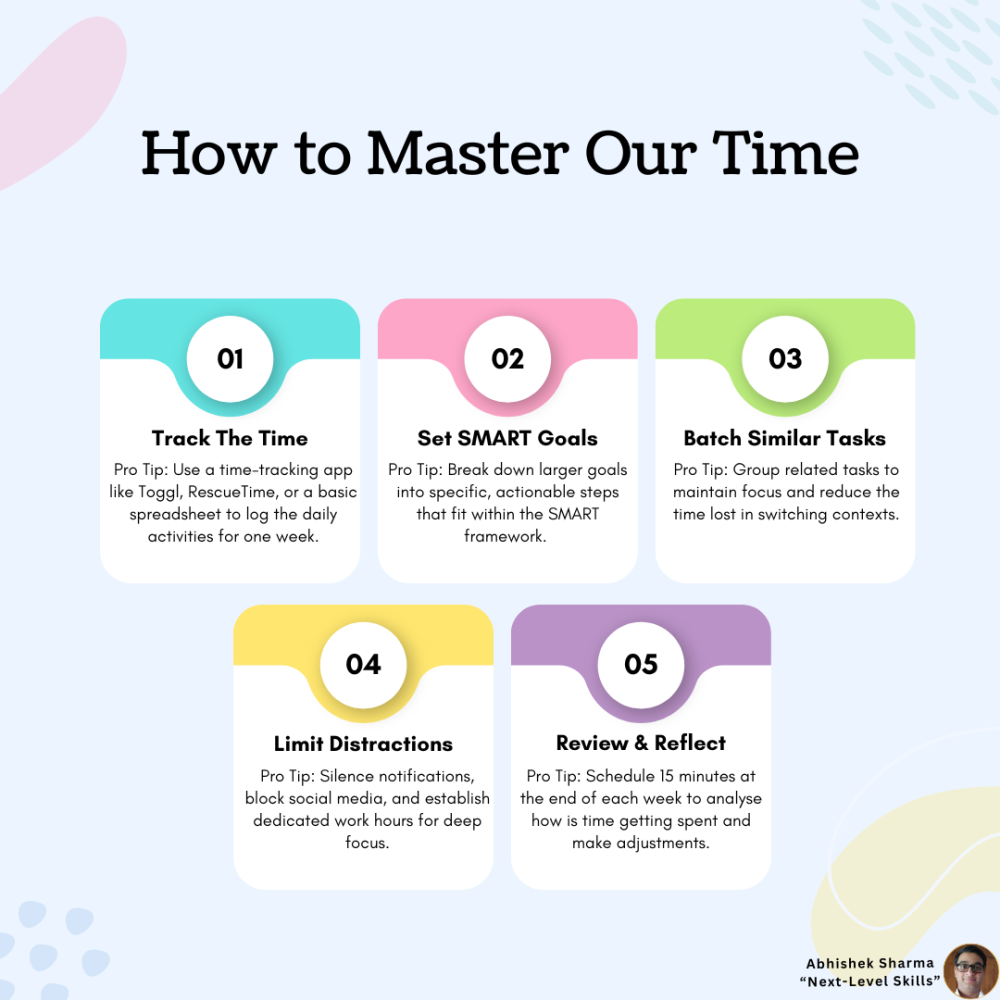
Mastering our time requires a proactive approach: tracking how we spend it, prioritising tasks based on importance, and minimising distractions. By consistently applying practical strategies, we can align our time with our goals and maximise productivity. Let get right into how we can master our time —
1. Track The Time
Diligently track where is the time getting spent to identify patterns and adjust accordingly.
Pro Tip: Use a time-tracking app like Toggl, RescueTime, or a basic spreadsheet to log the daily activities for one week.
Example: After tracking our time, we might discover that we spend 1–2 hours a day checking emails. Adjust this by setting dedicated email-checking times (e.g., twice a day at 10 a.m. and 4 p.m.), freeing up hours for deeper, uninterrupted work.
2. Set SMART Goals
Ensure goals are Specific, Measurable, Achievable, Relevant, and Time-bound.
Pro Tip: Break down larger goals into specific, actionable steps that fit within the SMART framework.
Example: Instead of saying, “I need to complete the project proposal,” reframe it as: “Write the first draft of the project proposal by Thursday noon, focusing on sections A and B today.” This clarity keeps us focused and ensures progress.
3. Batch Similar Tasks
Most often, we tend to waste time switching from one task to another.
Pro Tip: Group related tasks to maintain focus and reduce the time lost in switching contexts.
Example: Schedule all team meetings for the same afternoon so that morning remains free for creative work.
4. Limit Distractions
Identify the top distractions and create systems to minimise them.
Pro Tip: Silence notifications, block social media, and establish dedicated work hours for deep focus.
Example: If social media is a time-waster, use apps like Freedom or StayFocusd to block access during work hours. If office interruptions are an issue, use noise-cancelling headphones or a visible “focus mode” sign at the desk.
5. Review & Reflect
Each week, evaluating our successes and setbacks via an honest self-reflection is the key. Ask, “What worked? What didn’t? What can I improve next week?”
Pro Tip: Schedule 15 minutes at the end of each week to analyse how spending time looked like and make adjustments.
Example: If we find that we underestimated the time needed for a task (e.g., a report took 4 hours instead of the planned 2 hours), we should look to plan more realistically next time. Reflecting helps identify patterns like consistently overbooking our schedule or neglecting personal time.”
Additional Practical Tips
- →The Two-Minute Rule: If a task takes less than two minutes, do it immediately instead of adding it to the to-do list. Example: Filing a document or sending a quick email reply can be done on the spot, keeping our list manageable.
- →Time Blocking: Allocate specific hours of the day to particular tasks or themes. Example: Use calendar to create blocks like "Deep Work: 9 a.m.–11 a.m.," "Emails: 11 a.m.–11:30 a.m.," and "Client Calls: 2 p.m.–3 p.m." Stick to these blocks to maintain focus.
- →Eat the Frog: Start the day by tackling the most challenging or important task first. Example: If creating a presentation feels daunting, schedule it as the first task of the day when the energy levels and focus are at their peak.
- →Plan the Day the Night Before: Spend 10 minutes at the end of each day reviewing tomorrow’s tasks. Example: Identify the top three priorities for the next day and ensure the morning starts with clarity and purpose.
- →Use the 80/20 Rule (Pareto Principle): Focus on the 20% of activities that yield 80% of the results. Example: If client calls drive most of the business success, prioritise them over less impactful tasks like perfecting that website design.
Be cautious of the consequences of ineffective time management.
The Cost of Poor Time Management
Consider this: If we waste just one hour a day, that’s 365 hours — or over 15 full days — lost annually. Multiply that across a career, and the cost becomes staggering.
This and other essential skills are covered in Next-Level Skills — the book.
Learn more about the Book →A Challenge
Reflection Questions
Some Final Thoughts...
Time management isn’t about squeezing every second out of the day — it’s about designing a life where our time aligns with our values and goals. As Seneca said,
“It is not that we have a short time to live, but that we waste a lot of it.”
Thank you for being part of Next-Level Skills! I’d love to hear your time management tips or challenges — let’s share ideas and grow together.
Until Next Time,
Abhishek
Founder & CEO, LegiQ | Building Intelligent Edge Hardware
What’s the biggest time-wasting habit you’ve successfully overcome, and how did you do it?
How do you balance planning your time with staying flexible for unexpected events?
Do you think multitasking helps or hinders productivity? Why?
What’s a time management technique that has significantly improved your productivity?
What’s the biggest lesson you’ve learned about time management, and how has it changed your approach?
What’s the best way to recover lost time when a day doesn’t go as planned?
What role do boundaries play in effective time management, and how do you set them?
What’s one task you’ve recently delegated that freed up time for more important work?
How do you manage time when working across multiple time zones or teams?
How do you prioritise tasks when everything feels urgent?
Buy the Book
- ✓Learn the full Next-Level Skills framework.
- ✓Build clarity, influence, and decision-making strength.
- ✓Accelerate your personal and professional growth.
This and other essential skills are covered in Next-Level Skills — the book.
Learn more about the Book →This edition is reserved for supporters
Subscribe free, then unlock every past edition with just 1 successful referral.
Subscribe Free →Enjoyed this edition?
Get the next one in your inbox — first week of every month.