Openness to Change
Openness to Change: Thriving in an Evolving World
Welcome back to another edition of Next-Level Skills. Each edition, we explore the human and leadership capabilities that help us navigate work and life more effectively. Skills that move beyond theory and into practical application.
A warm welcome to everyone who has joined our community since the last edition. Whether you've been with us since the beginning or have recently discovered the newsletter or the book, thank you for being part of this journey.
This week, we focus on Openness to Change — a skill that determines how well we adapt to new situations, embrace uncertainty, and turn obstacles into opportunities. Change is constant, and our ability to respond to it with agility and resilience can set us apart in both our personal and professional lives. Let's get to know this critical skill that takes us to the next level.
When Change Wasn't an Option — It Was a Necessity
Almost a decade ago, I worked for an organisation that decided to implement a new project management system. The leadership team was convinced it would improve efficiency, but for those of us who had been using the existing system for years, the transition felt unnecessary and disruptive. Some team members resisted, arguing that the current system worked fine, while others were frustrated by the steep learning curve of the new tool.
At first, I found myself siding with the sceptics — why fix something that wasn’t broken? But as the rollout progressed, I realised that my resistance was based on familiarity rather than logic. I took the time to explore the system’s features and attended training sessions with an open mind. Gradually, I saw the benefits: automated workflows, better collaboration tools, and a clearer overview of project progress.
By the end of the transition, not only had the team adapted, but we also became more productive than before. What initially felt like an unnecessary change turned out to be a significant improvement.
What is Openness to Change?
Openness to change is the ability to accept, adapt to, and embrace new ideas, processes, or situations. It’s about maintaining a growth mindset and being willing to challenge existing ways of thinking.
“It is not the strongest of the species that survives, nor the most intelligent; it is the one most adaptable to change.”
— Charles Darwin
Our ability to evolve with changing circumstances determines how well we thrive in an unpredictable world.
Why It Matters
Change is inevitable, yet how we respond to it determines our ability to grow and succeed. Whether in our careers, relationships, or daily routines, being open to change allows us to adapt, innovate, and overcome challenges. Those who embrace change with curiosity rather than resistance position themselves for continuous learning and long-term success.
Being open to change is not just about adjusting to new circumstances — it’s about developing a mindset that allows us to innovate, grow, and lead effectively.
Here’s why it’s essential:
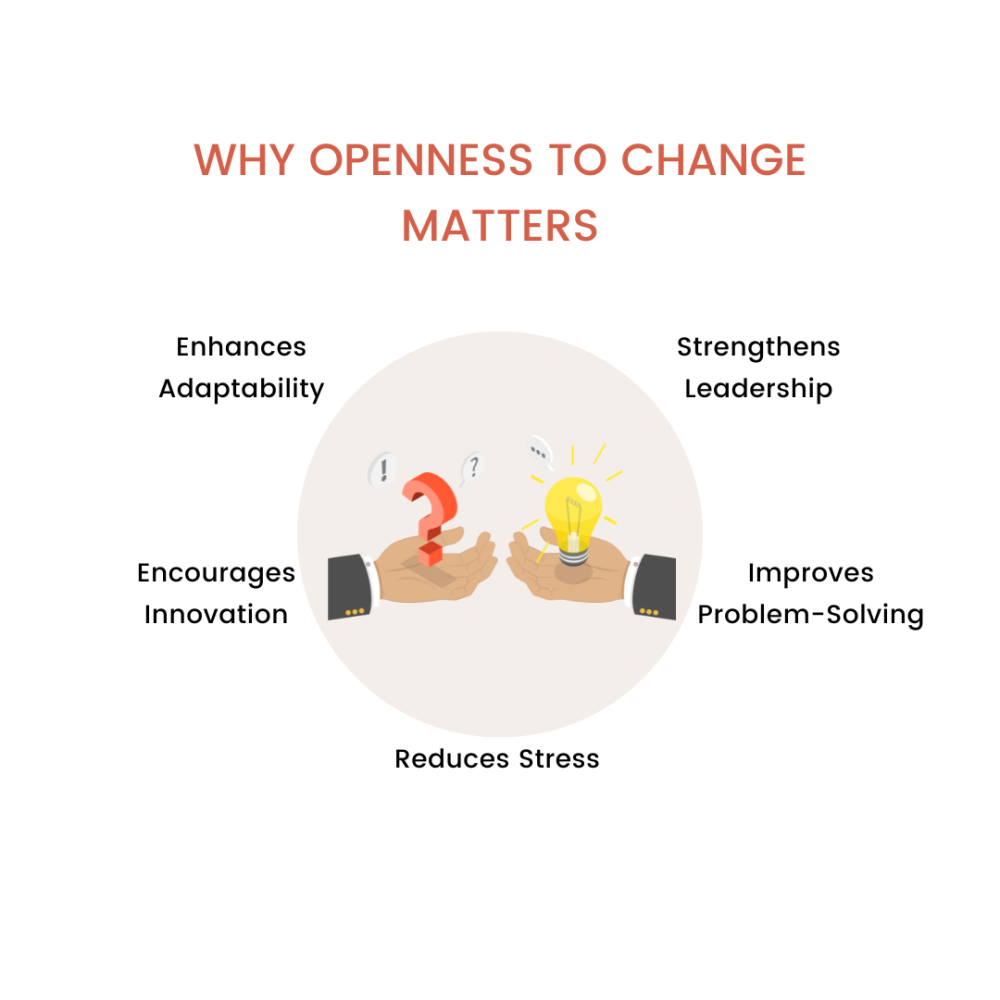
- 1Enhances AdaptabilityIn a rapidly changing world, those who embrace change stay ahead of the curve.
- 2Encourages InnovationOpenness to change allows us to experiment with new ideas and improve outdated methods.
- 3Reduces StressResisting change leads to frustration, while embracing it fosters a sense of control and curiosity.
- 4Improves Problem-SolvingChange forces us to think differently and develop creative solutions.
- 5Strengthens LeadershipThose who adapt easily inspire confidence and resilience in teams.
By recognising the value of change, we shift our mindset from fearing the unknown to seeing new opportunities. Developing openness to change requires intentional effort, but it leads to greater resilience, creativity, and personal growth.
With this understanding, let’s explore the mindset that makes embracing change easier and more effective.
The Mindset Behind Embracing Change
Openness to change begins with our mindset. How we perceive uncertainty and new challenges influences our ability to adapt.
Those who view change as a disruption often struggle with transitions, while those who see it as an opportunity for growth navigate shifts with confidence.
Developing the right mindset allows us to embrace change rather than resist it, making adjustments smoother and more productive.
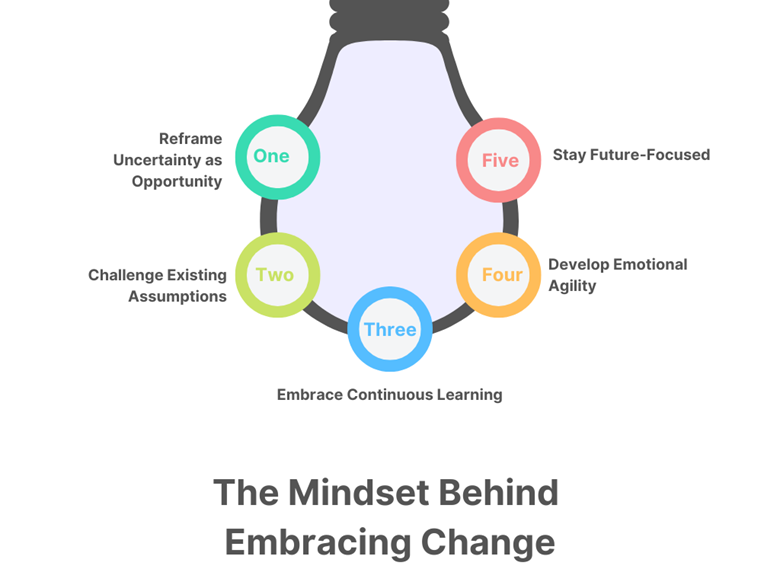
This skill requires us to:
- 1Reframe Uncertainty as OpportunityInstead of fearing change, view it as a chance to learn and grow.
- 2Challenge Existing AssumptionsQuestioning the status quo allows for greater innovation and improvement.
- 3Embrace Continuous LearningChange is easier when we are always learning and evolving.
- 4Develop Emotional AgilityBeing adaptable in how we process emotions helps us navigate uncertainty with resilience.
- 5Stay Future-FocusedLooking ahead allows us to anticipate changes rather than react to them.
A mindset that welcomes change helps us stay adaptable, resilient, and ready for new opportunities. By shifting our perspective, we create the foundation needed to thrive in evolving environments.
Now, let’s take this mindset further by exploring some practical strategies that can help us develop and strengthen our openness to change.
Pro Tips for Developing Openness to Change
Embracing change is not just about accepting new circumstances — it’s about actively developing habits that make adaptation easier. By cultivating flexibility, curiosity, and resilience, we can transform change from a source of stress into an opportunity for growth. The key lies in building practical strategies that help us stay open-minded, even in uncertain situations.
Start with Self-Awareness
Recognising our initial reaction to change helps us manage it more effectively. Are we resistant? Anxious? Excited? Understanding our emotional response allows us to take intentional steps toward adaptation.
Pro Tip: If we notice that we instinctively resist a new process at work, we can pause, assess the reasons behind our hesitation, and reframe it as an opportunity to improve efficiency.
Adopt a Growth Mindset
Seeing challenges as learning experiences rather than threats fosters resilience and adaptability.
Pro Tip: Instead of thinking, “I’m not good at this new technology,” shift to, “I haven’t mastered it yet, but I can learn.”
Seek Diverse Perspectives
Surrounding ourselves with people who think differently exposes us to new ideas and ways of approaching change.
Pro Tip: If faced with a major industry shift, consult colleagues from different backgrounds to gain insights on how to navigate it effectively.
Develop Comfort with Uncertainty
Not all changes come with clear answers. Learning to navigate ambiguity helps us stay flexible.
Pro Tip: If a company restructure is on the horizon, focus on what is within our control rather than fixating on unknowns.
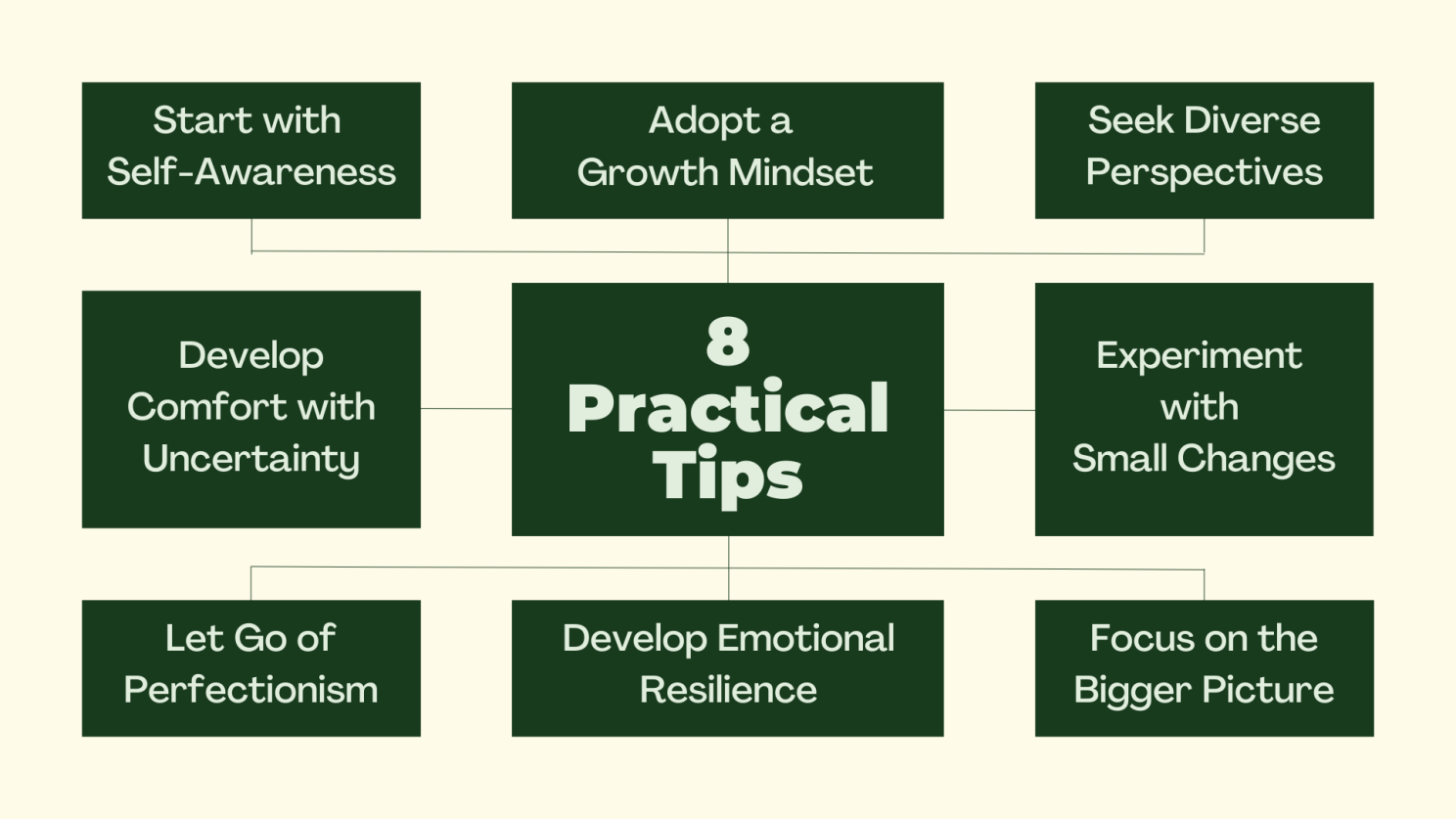
Experiment with Small Changes
Practising adaptability in small ways makes it easier to handle major transitions.
Pro Tip: Try a new productivity tool, work from a different environment, or switch up a routine to build flexibility.
Let Go of Perfectionism
Change often involves trial and error, and perfection is rarely achievable.
Pro Tip: Instead of delaying action until we have all the answers, take the first step and refine along the way.
Develop Emotional Resilience
Change can trigger discomfort, but resilience helps us move forward despite uncertainty.
Pro Tip: Practise mindfulness or stress-management techniques when facing a major change to stay grounded.
Focus on the Bigger Picture
Keeping long-term goals in mind helps us put short-term changes into perspective.
Pro Tip: If a company implements new policies, consider how they align with broader industry trends rather than viewing them in isolation.
While adapting may not always be easy, taking small, intentional steps makes transitions smoother and more rewarding. Now, let’s put this into practice with a challenge designed to strengthen our ability to embrace change.
This and other essential skills are covered in Next-Level Skills — the book.
Learn more about the Book →A Challenge
Identify an area where you’ve been resisting change — whether at work or in personal life.
Ask yourself:
Reflection Questions
Some Final Thoughts...
Openness to change is not about passively accepting every shift — it’s about cultivating a mindset that allows us to navigate transitions with curiosity and confidence. When we view change as an opportunity rather than a disruption, we position ourselves for continuous growth and success.
Change is the law of life. And those who look only to the past or present are certain to miss the future.
— John F. Kennedy
The future belongs to those who are ready to embrace it.
Thank you for being part of Next-Level Skills! Let’s continue learning, evolving, and supporting one another in this journey.
Until Next Time,
Abhishek
Founder & CEO, LegiQ | Building Intelligent Edge Hardware
How do we encourage those around us to be more open to change?
What role does emotional intelligence play in handling change effectively?
How can leaders create a culture where teams feel safe embracing change?
Have you ever had a change that seemed negative at first but turned out to be beneficial?
What’s a time when embracing change led to unexpected success?
How do we overcome the fear of uncertainty when faced with major transitions?
What’s the biggest lesson you’ve learned from navigating an unexpected change?
How do we balance stability with the need to adapt?
What’s one small change you’ve recently made that had a significant impact?
What strategies help us develop a mindset that welcomes change rather than resists it?
Apply These Skills
- ✓Put the frameworks into practice this month.
- ✓Use the reflection prompts inside the book.
- ✓Build habits that compound over time.
This and other essential skills are covered in Next-Level Skills — the book.
Learn more about the Book →This edition is reserved for supporters
Subscribe free, then unlock every past edition with just 1 successful referral.
Subscribe Free →Enjoyed this edition?
Get the next one in your inbox — first week of every month.