Problem Solving
Problem-Solving: Turning Challenges into Opportunities
Welcome back to another edition of Next-Level Skills. Each edition, we explore the human and leadership capabilities that help us navigate work and life more effectively. Skills that move beyond theory and into practical application.
A warm welcome to everyone who has joined our community since the last edition. Whether you've been with us since the beginning or have recently discovered the newsletter or the book, thank you for being part of this journey.
This week, we explore Problem-Solving, a skill that separates those who react from those who lead. Whether in the workplace or everyday life, challenges are inevitable. However, our ability to approach problems strategically, think critically, and act decisively can turn obstacles into opportunities.
When a Small Detail Became a Big Problem
A few years ago, I was part of a team preparing for a major client presentation. We had spent weeks refining our proposal, ensuring every data point was backed by solid research. The night before the meeting, while reviewing the final deck, I noticed that one of the key financial figures was inconsistent across slides. It was a minor discrepancy at first glance, but if the client spotted it, it could undermine our credibility.
With only hours left, I faced two choices — ignore the issue and hope it wouldn’t be noticed, or raise it and risk a stressful, last-minute revision. I decided to bring it up. The team quickly analysed the data, traced the inconsistency to an outdated report, and corrected all affected slides. The next day, the presentation went smoothly, and the client was impressed by the clarity and thoroughness in our proposal.
A proactive approach to solving problems, no matter how minor they seem, can make the difference between success and failure.
What is Problem-Solving?
Problem-solving is the ability to identify, analyse, and resolve challenges in a structured and effective way. It involves critical thinking, creativity, and decision-making to navigate complex situations.
We cannot solve our problems with the same thinking we used when we created them.
— Albert Einstein
Effective problem-solvers don’t just react — they assess, strategize, and act with purpose.
Why Problem-Solving Matters
Every challenge we face — whether in the workplace or daily life — presents an opportunity to improve, adapt, and grow. Those who excel at problem-solving don’t just react to issues; they anticipate challenges, analyse situations critically, and find effective solutions. Developing strong problem-solving skills helps us stay resourceful, resilient, and confident in any situation.
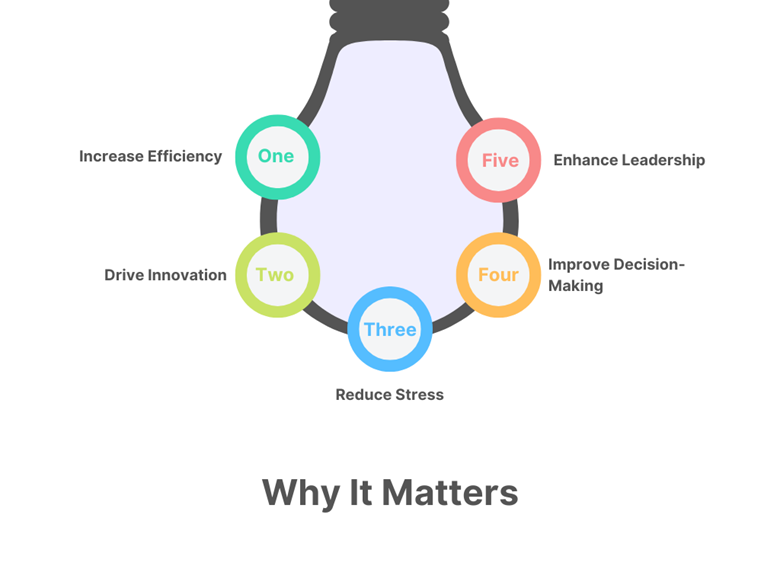
Strong problem-solving skills are essential because they:
- 1Increase EfficiencyStructured thinking reduces wasted time and effort.
- 2Drive InnovationNew solutions emerge when we challenge conventional thinking.
- 3Reduce StressA problem-solving mindset turns uncertainty into action.
- 4Improve Decision-MakingWe make better choices when we analyse problems objectively.
- 5Enhance LeadershipGreat leaders excel at guiding teams through challenges.
By strengthening our ability to tackle problems head-on, we not only resolve immediate issues but also build a mindset that turns obstacles into learning opportunities. When we develop strong problem-solving abilities, we position ourselves as valuable contributors and effective decision-makers.
To navigate challenges effectively, we need a structured approach that ensures we make thoughtful, informed decisions.
Let’s explore the key phases that guide successful problem-solving.
The Key Phases of Problem-Solving
Effective problem-solving is not about quick fixes — it’s about following a structured process that ensures the best possible outcome. Breaking problems down into clear phases helps us avoid knee-jerk reactions and instead approach challenges with logic and strategy. When we tackle issues methodically, we make smarter decisions and prevent similar problems in the future.
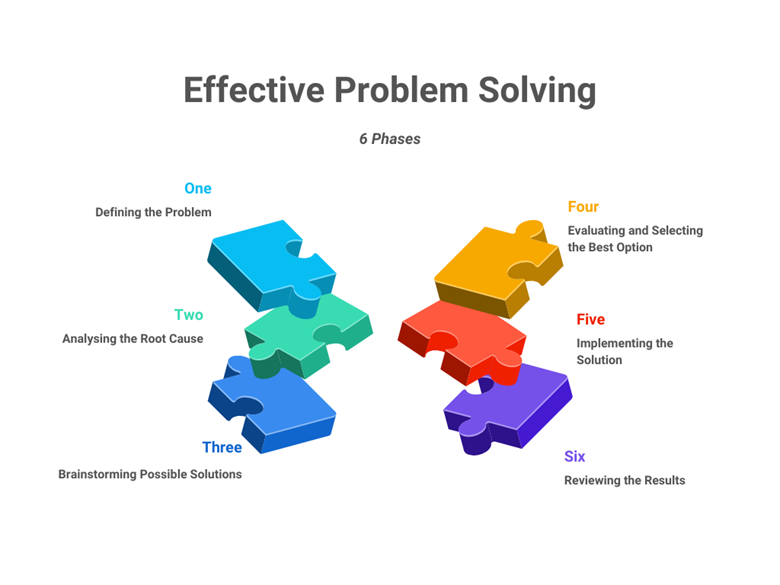
The key phases include:
- 1Defining the ProblemClearly identifying what needs to be solved.
- 2Analysing the Root CauseUnderstanding the deeper issue, not just the symptoms.
- 3Brainstorming Possible SolutionsGenerating multiple approaches to consider.
- 4Evaluating and Selecting the Best OptionAssessing feasibility, risks, and outcomes.
- 5Implementing the SolutionTaking decisive action.
- 6Reviewing the ResultsReflecting on what worked and what can be improved.
By following this structured approach, we move from simply identifying a problem to implementing solutions that create lasting impact.
However, having a structured approach is only part of the equation — we also need practical techniques to strengthen our problem-solving ability.
Let’s dive into some proven practical strategies that can help us become more effective problem-solvers.
Pro Tips for Effective Problem-Solving
Having a structured approach is essential, but problem-solving becomes even more effective when paired with the right strategies. The best problem-solvers think critically, remain adaptable, and use practical techniques to find solutions efficiently.
By applying the below pro tips, we can tackle challenges with confidence and creativity.
Reframe the Problem as an Opportunity
How we define a problem shapes our ability to solve it. Instead of seeing obstacles as roadblocks, view them as opportunities to innovate.
Pro Tip: If a project or task is delayed, ask, “What can we improve in the process to prevent this next time?”
Ask the Right Questions
The quality of our solutions depends on the questions we ask. Challenge assumptions and explore alternative perspectives.
Pro Tip: Instead of asking, “Why did this happen?” ask, “What factors contributed to this, and how can we address them?”
Use the "Five Whys" Technique
Getting to the root cause of a problem prevents temporary fixes. Asking “Why?” five times helps uncover the real issue.
Pro Tip: If customers are unhappy with a product, don’t stop at “They find it expensive.” Dig deeper — why do they perceive it as costly? What alternatives are they comparing it to?
Apply the Pareto Principle (80/20 Rule)
Identify the small changes that create the biggest impact. Focus on solving the 20% of problems that cause 80% of issues.
Pro Tip: If customer complaints keep increasing, find out which two or three common issues make up most of the concerns and address those first.
Collaborate and Seek Diverse Perspectives
The best solutions come from collective intelligence. Engage different viewpoints to uncover creative solutions.
Pro Tip: If a marketing campaign isn’t performing, ask insights from sales, customer service, and product teams — they may see blind spots we missed.
Use Mind Mapping for Complex Problems
Visualising problems can help identify connections and patterns. A mind map helps break down issues into smaller, more manageable parts.
Pro Tip: If a product launch is delayed, map out all contributing factors — supplier delays, testing issues, marketing gaps — to find the real bottleneck.
Stay Solution-Focused, Not Problem-Focused
Shift energy away from dwelling on the issue and towards brainstorming solutions.
Pro Tip: Instead of saying, “This isn’t working,” ask, “What’s one change we can make right now to move forward?”
Test and Iterate
Not all solutions work perfectly on the first attempt. And that's completely ok. Be willing to adjust and refine strategies based on results.
Pro Tip: If a new workflow isn’t improving productivity, tweak one element at a time rather than discarding the entire system.

By incorporating these strategies into our daily decision-making, we become more proactive and solution-oriented. Problem-solving isn’t just about fixing what’s broken — it’s about continuously improving the way we approach challenges.
Now, let’s put these techniques into action with a simple challenge for this week for us to strengthen our problem-solving mindset.
This and other essential skills are covered in Next-Level Skills — the book.
Learn more about the Book →A Challenge
Identify a challenge you’re currently facing — big or small. Instead of reacting instinctively, apply a structured problem-solving approach:
- →Define the problem clearly.
- →Identify the root cause.
- →Generate at least three possible solutions.
- →Choose the best one and take action.
Some Final Thoughts...
Problem-solving is one of the most valuable skills we can develop, both professionally and personally. When we approach challenges with a structured mindset and creative thinking, we turn difficulties into stepping stones for success.
Most people spend more time and energy going around problems than in trying to solve them.
— Henry Ford
The key is to face problems head-on and use them as opportunities for growth.
Thank you for being part of Next-Level Skills! I’d love to hear — what’s a problem you recently solved using a structured approach? Let’s learn from each other’s experiences.
Until Next Time,
Abhishek
Founder & CEO, LegiQ | Building Intelligent Edge Hardware
How do we balance speed and thoroughness when making problem-solving decisions?
What’s one problem-solving habit you’d like to improve?
How do we encourage a problem-solving mindset in workplace culture?
What role does emotional intelligence play in effective problem-solving?
How can teams collaborate more effectively when tackling complex challenges?
What problem-solving techniques have worked best for you in your career?
How do we ensure we’re solving the root cause of a problem rather than just its symptoms?
What’s the most creative solution you’ve ever come up with to solve a problem?
How do we stay calm and focused when faced with high-pressure problems?
What’s the most challenging problem you’ve had to solve, and how did you approach it?
Apply These Skills
- ✓Put the frameworks into practice this month.
- ✓Use the reflection prompts inside the book.
- ✓Build habits that compound over time.
This and other essential skills are covered in Next-Level Skills — the book.
Learn more about the Book →This edition is reserved for supporters
Subscribe free, then unlock every past edition with just 1 successful referral.
Subscribe Free →Enjoyed this edition?
Get the next one in your inbox — first week of every month.