Embracing Feedback
Embracing Feedback: The Fastest Path to Growth
Welcome back to another edition of Next-Level Skills. Each edition, we explore the human and leadership capabilities that help us navigate work and life more effectively. Skills that move beyond theory and into practical application.
A warm welcome to everyone who has joined our community since the last edition. Whether you've been with us since the beginning or have recently discovered the newsletter or the book, thank you for being part of this journey.
This week, we explore Embracing Feedback, a skill that transforms setbacks into opportunities, sharpens our strengths, and accelerates personal and professional growth. While feedback can sometimes feel uncomfortable, those who master the art of receiving and applying it unlock their full potential.
“You bring great insights, but sometimes your approach can come off as dismissive of others’ ideas,”
The Feedback That Changed Everything
Early in my career, I took great pride in my problem-solving abilities. I was efficient, detail-oriented, and always met deadlines. So, when a senior colleague told me after a meeting,
"I was taken aback."
At first, my instinct was to defend myself — I hadn’t intended to be dismissive. But as I reflected on the feedback, I realised that while I was focused on efficiency, I wasn’t always fully listening to my colleagues. I was so eager to offer solutions that I unintentionally shut down discussions.
That insight changed the way I communicated. I became more conscious of my tone, practised active listening, and invited others to contribute before offering my own ideas. Over time, not only did my relationships with colleagues improve, but I also became a better leader.
What is Feedback, Really?
Feedback is insight, guidance, or constructive criticism given to help us improve our performance, behaviours, or decision-making.
It’s not just about correction — it’s about learning, adjusting, and evolving.
We all need people who will give us feedback. That’s how we improve.
— Bill Gates
Whether positive or constructive, feedback provides a mirror that helps us see what we might otherwise miss.
Why Embracing Feedback Matters
Feedback is one of the most powerful tools for personal and professional growth. It provides valuable insights that help us refine our skills, strengthen relationships, and enhance our performance. When we embrace feedback with the right mindset, we unlock continuous learning and long-term success.
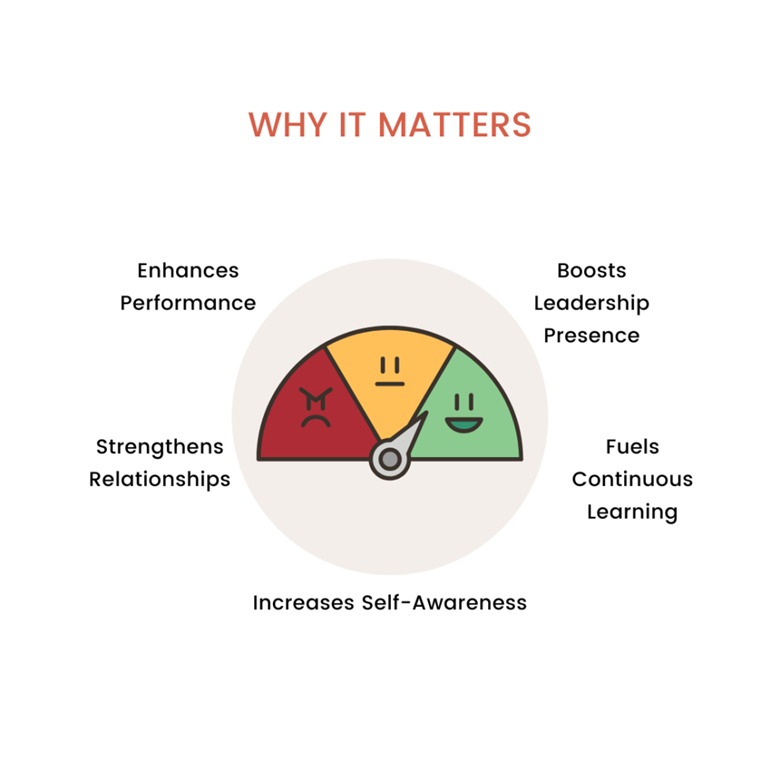
Here’s why embracing feedback is essential:
- 11. Enhances PerformanceWhen we act on feedback, we refine our skills and become more effective.
- 22. Strengthens RelationshipsOpenly receiving feedback fosters trust, collaboration, and stronger professional connections.
- 33. Increases Self-AwarenessConstructive feedback helps us recognise blind spots we wouldn’t see on our own.
- 44. Fuels Continuous LearningThose who embrace feedback develop a mindset of lifelong growth.
- 55. Boosts Leadership PresenceThe best leaders seek and apply feedback, setting an example for their teams.
By viewing feedback as an opportunity rather than criticism, we position ourselves for improvement and growth. However, to fully benefit from it, we need to shift our mindset and develop habits that allow us to receive and apply feedback effectively.
Let’s explore how we can reframe feedback to make it a constructive force in our development.
The Mindset Shift: From Defensiveness to Growth
Our initial reaction to feedback often determines how much we benefit from it. When we approach it with defensiveness, we miss opportunities to learn.
However, by shifting our mindset to view feedback as a tool for growth rather than criticism, we can use it to refine our skills and strengthen our relationships.
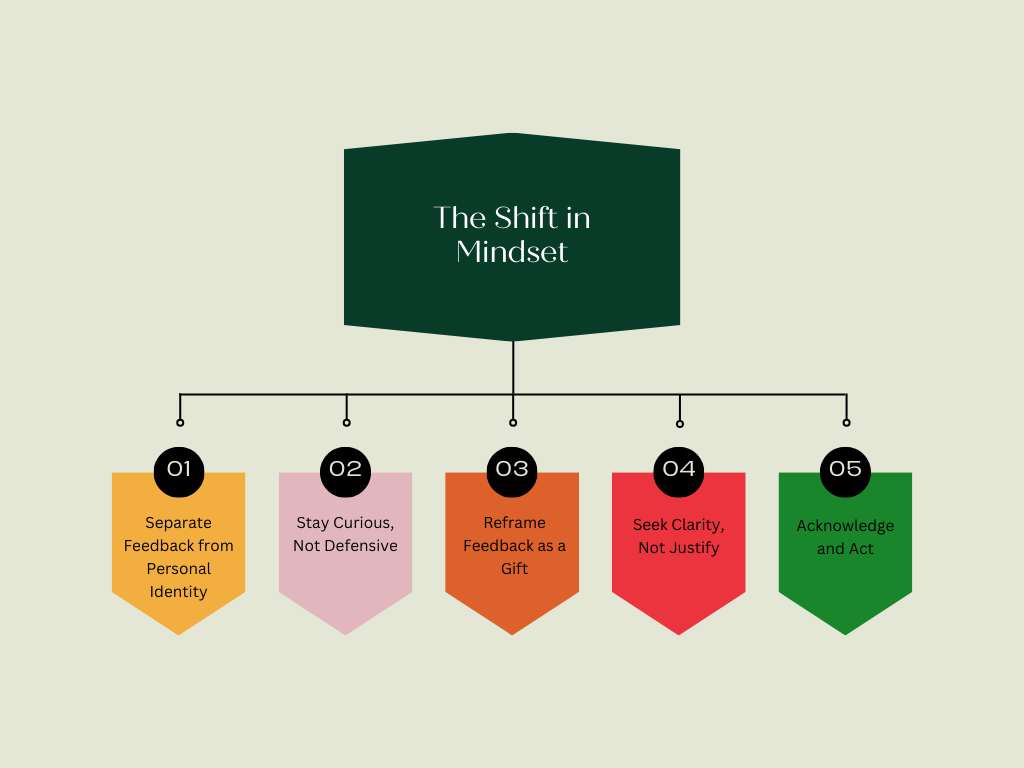
Here’s how we can adjust our mindset:
- 1Separate Feedback from Personal IdentityFeedback is about performance, not personal worth.
- 2Stay Curious, Not DefensiveApproach feedback with the mindset of a learner rather than a critic.
- 3Reframe Feedback as a GiftConstructive criticism, when given with good intent, is an opportunity to improve.
- 4Seek Clarity, Not JustifyInstead of reacting, ask questions to better understand the feedback.
- 5Acknowledge and ActTaking small steps based on feedback shows growth and maturity.
Developing a growth-oriented mindset allows us to embrace feedback with curiosity rather than resistance. Once we make this shift, the next step is learning how to apply feedback effectively in real-world situations.
Let’s explore some practical strategies to help us turn feedback into meaningful action.
Pro Tips for Embracing Feedback
Effectively embracing feedback requires more than just hearing it — it’s about actively processing, applying, and using it to improve. By developing the right habits, we can transform feedback into a powerful tool for professional and personal growth.
Below practical strategies help us receive, interpret, and act on feedback in a way that drives real progress.
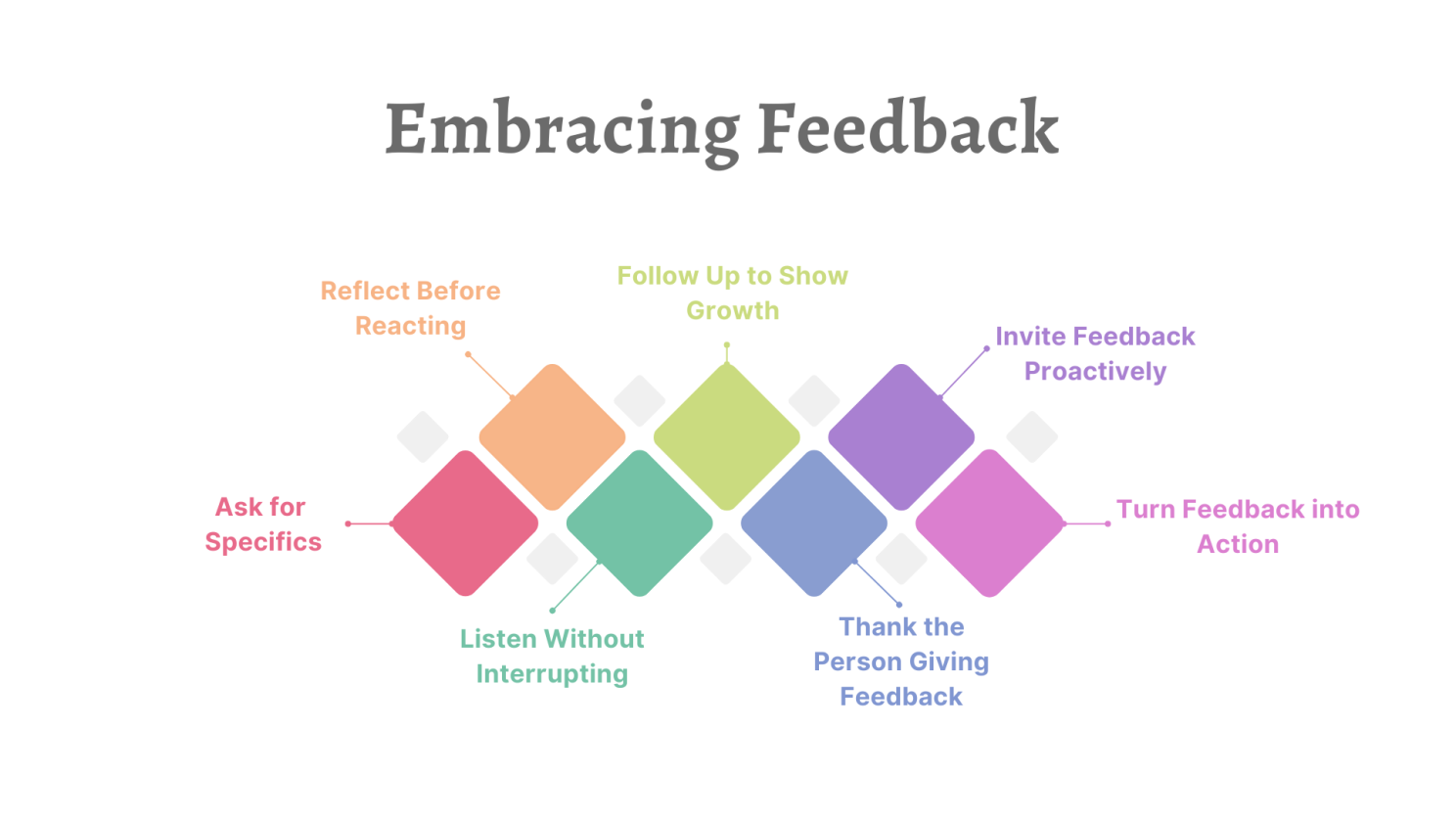
Invite Feedback Proactively
Waiting for feedback can mean missing valuable insights. Actively seek it from peers, mentors, and leaders.
Pro Tip: Instead of waiting for performance reviews, ask a colleague, “What’s one thing I could do better in our team meetings?”
Listen Without Interrupting
Resist the urge to explain or defend. Instead, focus on truly understanding the feedback.
Pro Tip: If a manager says, “Your reports could be more concise,” respond with “Thank you for that insight. Could you share an example of where I could improve?”
Ask for Specifics
Vague feedback is hard to act on. Asking for specifics makes it more actionable.
Pro Tip: If someone says, “Your presentation could be better,” ask, “What part do you think needed the most improvement?”
Reflect Before Reacting
Emotional reactions can cloud the value of feedback. Take time to process before responding.
Pro Tip: If feedback feels unfair, step away for a moment and consider whether there’s truth in it before addressing it.
Turn Feedback into Action
Growth happens when we apply what we’ve learned. Take one small step toward improvement based on the feedback received.
Pro Tip: If feedback suggests working on delegation skills, start by handing off one small task and tracking the results.
Follow Up to Show Growth
Revisiting feedback with the person who gave it shows commitment and progress.
Pro Tip: After applying feedback on presentation skills, ask, “I worked on simplifying my slides — did you notice an improvement?”
Thank the Person Giving Feedback
Acknowledging feedback, even when difficult to hear, encourages people to provide more valuable insights in the future.
Pro Tip: Say, “I appreciate your honesty — it helps me grow.”
The more we practise, the more natural it becomes to see feedback as a valuable asset.
Now, let’s put these insights into action with a simple challenge to strengthen our feedback skills this week.
This and other essential skills are covered in Next-Level Skills — the book.
Learn more about the Book →A Challenge
This week, take a proactive step toward embracing feedback. Ask someone — a manager, peer, or mentor — one of the following:
Reflection Questions
Some Final Thoughts...
Feedback is one of the most powerful tools for growth, but only if we choose to embrace it. When we stop seeing it as criticism and start viewing it as an opportunity, we accelerate our development and build stronger relationships.
Feedback is the breakfast of champions.
— Ken Blanchard
The more we welcome it, the stronger we become.
Thank you for being part of Next-Level Skills! What’s the best piece of feedback you’ve ever received? Let’s keep the conversation going and learn from each other’s experiences.
Until Next Time,
Abhishek
Founder & CEO, LegiQ | Building Intelligent Edge Hardware
What’s the most valuable feedback you’ve ever received, and how did it impact you?
Have you ever received feedback that you initially rejected but later realised was valuable?
How do we create a workplace culture where feedback is welcomed rather than feared?
How do we ensure that we give feedback in a way that is constructive and well-received?
What’s the difference between constructive feedback and criticism, and how do we recognise it?
What strategies do we use to manage emotional reactions to feedback?
How do leaders encourage teams to be open to feedback without defensiveness?
What’s one area where you’d like to receive honest feedback right now?
What role does self-awareness play in effectively receiving feedback?
How can we request more useful, specific feedback from colleagues?
Buy the Book
- ✓Learn the full Next-Level Skills framework.
- ✓Build clarity, influence, and decision-making strength.
- ✓Accelerate your personal and professional growth.
This and other essential skills are covered in Next-Level Skills — the book.
Learn more about the Book →This edition is reserved for supporters
Subscribe free, then unlock every past edition with just 1 successful referral.
Subscribe Free →Enjoyed this edition?
Get the next one in your inbox — first week of every month.