Proactive Problem Anticipation
Seeing the Storm Before the Clouds Form
Welcome back to another edition of Next-Level Skills. Each edition, we explore the human and leadership capabilities that help us navigate work and life more effectively. Skills that move beyond theory and into practical application.
A warm welcome to everyone who has joined our community since the last edition. Whether you've been with us since the beginning or have recently discovered the newsletter or the book, thank you for being part of this journey.
This week we’ll tackle a skill that separates good professionals from great ones:
Proactive Problem Anticipation.
Instead of simply reacting when issues arise, this skill helps us foresee challenges before they materialise and build resilience into our plans.
A Wake-Up Call in the Project Room
Years ago, I was leading a delivery team on a tight client deadline. Everything looked fine on paper - timelines were clear, resources allocated, risks logged.
But one team member quietly flagged that our vendor had a history of late deliveries. Most brushed it off. Weeks later, the vendor slipped, pushing us dangerously close to failure.
Had we taken that early warning seriously, we could have built buffers, lined up alternatives, or escalated before it became a crisis.
That moment reinforced a lesson I carry today:
Why Proactive Anticipation Matters
Every workplace deals with fire-fighting, period!
But those who anticipate and prepare avoid the cycle of constant crisis. Proactive professionals don’t just spot risks - they prevent disruption, reduce stress, and protect team trust.
An ounce of prevention is worth a pound of cure.
— Warren Buffett
In today’s fast-moving environments, anticipation isn’t just nice to have, it’s a survival instinct.
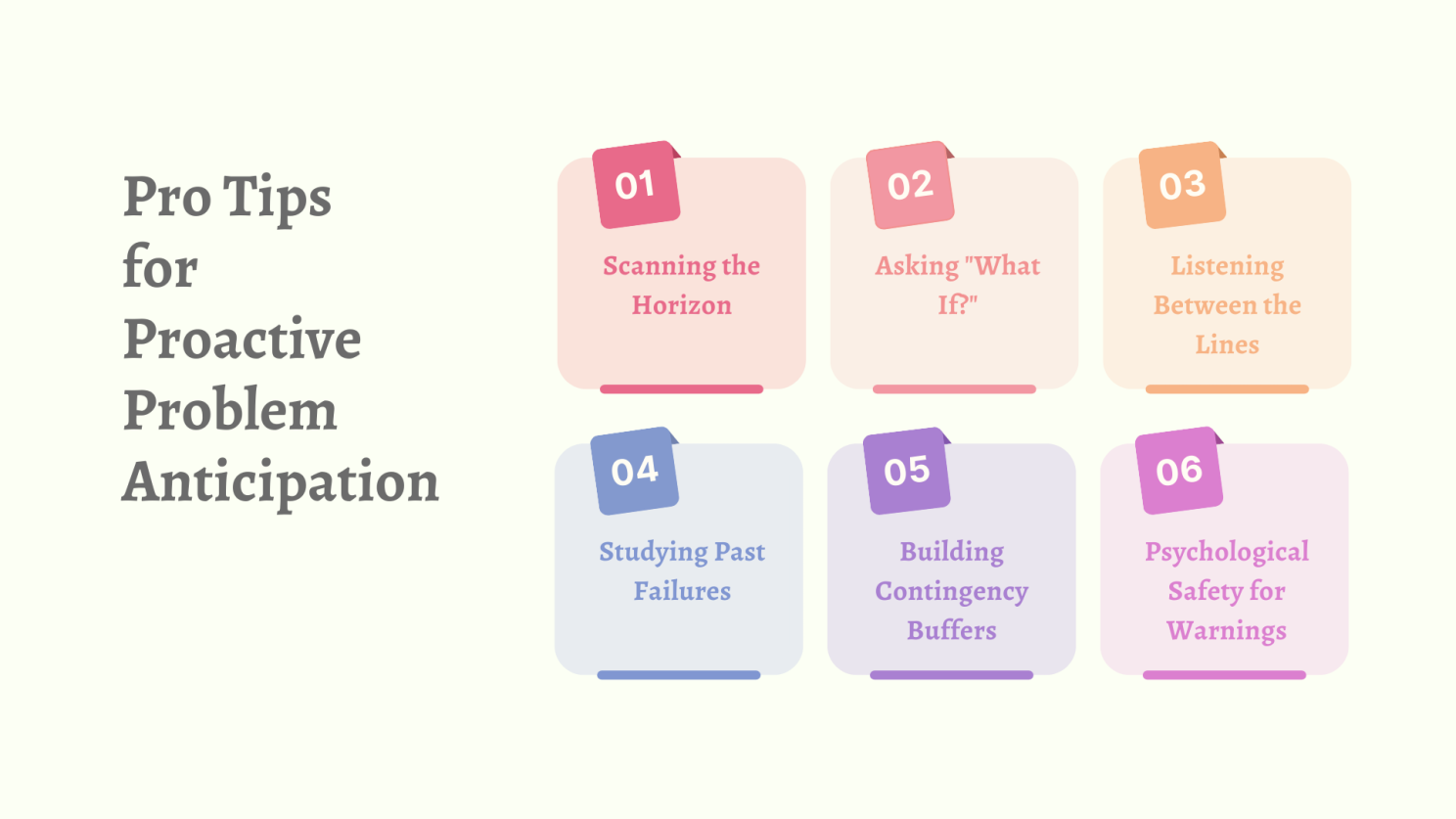
Scanning the Horizon
Strong anticipators monitor industry trends, competitor moves, and internal signals. They notice shifts that others miss and act before they become urgent.Pro Tip: Dedicate 15 minutes weekly to reviewing industry news, emerging technologies, or customer sentiment. Small scans can prevent large shocks.
Asking "What If?"
Anticipators regularly scenario-plan. They ask, “What if this fails? What if demand spikes? What if we lose this resource?” These thought experiments reveal blind spots.Pro Tip: In meetings, build a “What if?” moment into the agenda to stress-test assumptions.
Listening Between the Lines
Concerns often surface in casual remarks before they show up in metrics. Proactive leaders tune into hallway conversations, side comments, and subtle patterns.Pro Tip: When a quiet colleague voices a concern, treat it as a potential early-warning signal, not just noise.
Studying Past Failures
History often repeats itself. By dissecting what went wrong in earlier projects, anticipators avoid walking into the same traps.Pro Tip: Keep a “lessons learned” log after major projects and revisit it during new planning phases.
Building Contingency Buffers
Anticipation isn’t about predicting perfectly — it’s about building flexibility. Anticipators budget time, resources, and options into their plans.Pro Tip: Add 10–15% time buffer on critical tasks. It’s cheaper than a last-minute scramble.
Creating Psychological Safety for Warnings
People anticipate problems all the time, but they only raise them if they feel safe. Anticipators encourage open dialogue without punishing those who speak up.Pro Tip: At project kick-offs, explicitly invite team members to flag risks without fear of blame.
Real-World Applications
- →In aviation, pilots train extensively on “what if” scenarios : engine failure, turbulence, medical emergencies, because preparation saves lives.
- →In business, Amazon famously plans backward from worst-case scenarios, allowing them to adapt faster than competitors.
- →On a personal level, even keeping a “rain plan” for outdoor events ensures success when nature turns unpredictable.

This and other essential skills are covered in Next-Level Skills — the book.
Learn more about the Book →A Challenge
This week, try this simple exercise:
Reflection Questions
Some Final Thoughts...
Anticipating problems doesn’t mean living in fear, it means building confidence.
Teams trust leaders who spot storms before the first cloud.
And individuals who master this skill become the ones others look to in moments of uncertainty.
As the saying goes,
The future belongs to those who prepare for it today.
Let’s sharpen our anticipation and stay ahead of the curve. Would you?
Until Next Time,
Abhishek
Founder & CEO, LegiQ | Building Intelligent Edge Hardware
Do you think anticipation skills are natural or can be developed?
How do you encourage teams to flag risks without creating fear?
Can you recall a time when an early warning was ignored and it turned into a big problem?
What industry do you think models problem anticipation best?
How do you personally stay prepared for the unexpected?
How can technology help us spot problems earlier?
How do we balance anticipating risks without slipping into overthinking?
How does culture affect whether risks are raised or ignored?
Should leaders focus more on preventing problems or reacting effectively?
What’s the smallest preventative step you’ve taken that paid off big?
Apply These Skills
- ✓Put the frameworks into practice this month.
- ✓Use the reflection prompts inside the book.
- ✓Build habits that compound over time.
This and other essential skills are covered in Next-Level Skills — the book.
Learn more about the Book →This edition is reserved for supporters
Subscribe free, then unlock every past edition with just 1 successful referral.
Subscribe Free →Enjoyed this edition?
Get the next one in your inbox — first week of every month.