Accountability
Owning It: The Power of Accountability
Welcome back to another edition of Next-Level Skills. Each edition, we explore the human and leadership capabilities that help us navigate work and life more effectively. Skills that move beyond theory and into practical application.
A warm welcome to everyone who has joined our community since the last edition. Whether you've been with us since the beginning or have recently discovered the newsletter or the book, thank you for being part of this journey.
Today, we focus on a skill that often defines the difference between good intentions and consistent results: Accountability.
It’s not just a trait. It’s the backbone of trust, performance, and respect in high-functioning teams.
The Email That Changed the Game
At a mid-sized tech start-up I advised, a key milestone kept slipping due to unclear ownership. Frustrations mounted, meetings stretched longer, and team morale dipped.
One evening the project lead sent a simple, but powerful email that changed the tone:
That one action spurred clarity. People stopped waiting for directions and began asking, “How can I help?” The shared ownership transformed the culture and the results.
Why Accountability Anchors Performance
Accountability in the workplace means taking ownership of our actions, decisions, and their consequences. It’s about commitment, clarity, and honesty.
When team members know you’ll follow through, communication improves, trust deepens, and work flows more smoothly. Accountable teams work with purpose, not pause. Source : FranklinCovey.
Leaders and organisational researchers agree that accountability aligned with autonomy fosters engagement and consistency, not guilt or fear. Source: AmplifyHR.
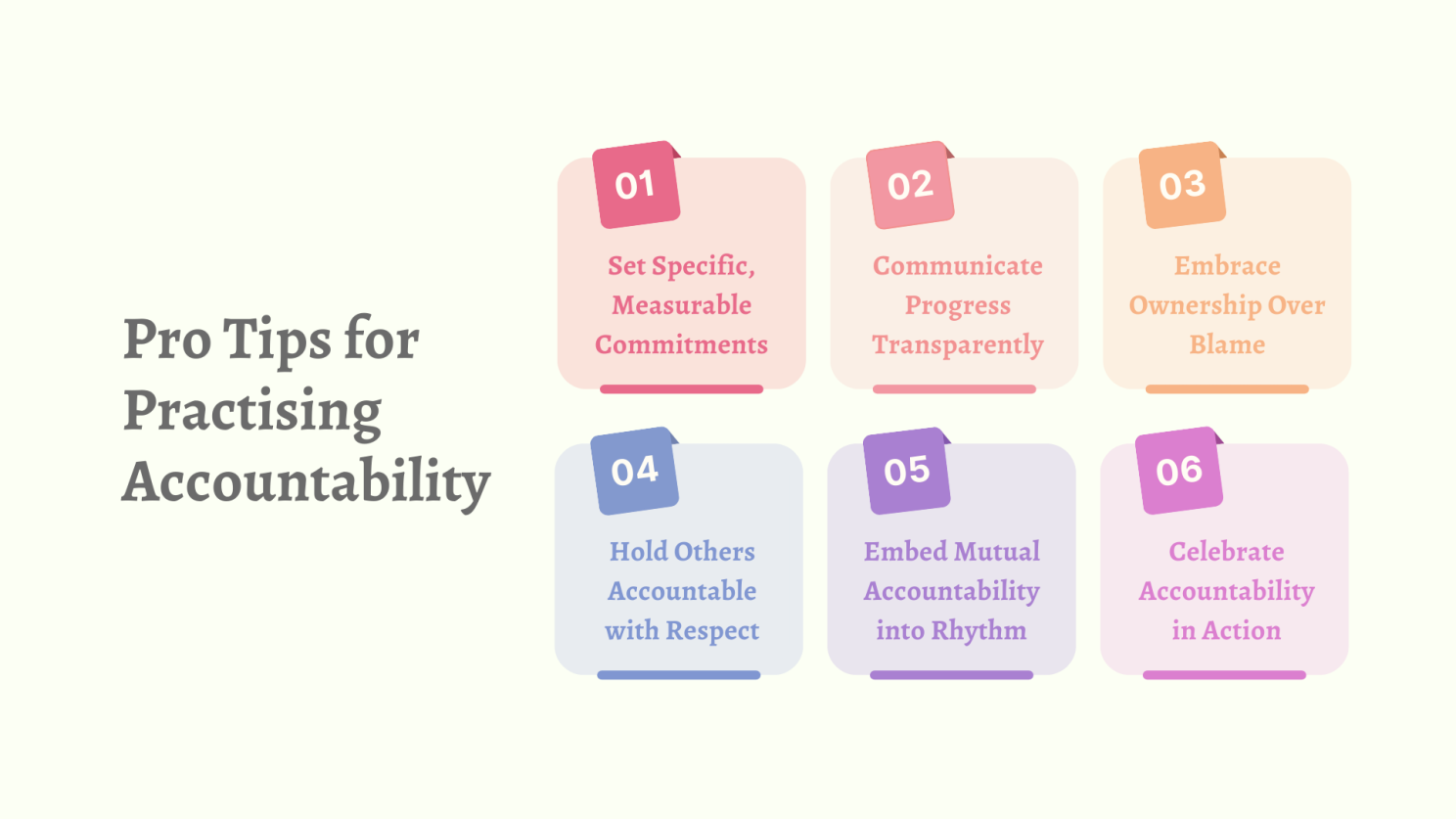
Set Specific, Measurable Commitments
Pro Tip: Explicitly state what you will do, for whom, and by when.
Clarity fuels ownership and eliminates guesswork.
Communicate Progress Transparently
Pro Tip: Let others know the ‘what’, ‘why’, and ‘what next’.
Even if there’s slippage, early updates build credibility.
Embrace Ownership Over Blame
Pro Tip: Address challenges directly: “Here’s what I missed and how I’m correcting it.”
This signals maturity, not weakness.
Hold Others Accountable with Respect
Pro Tip: Frame expectations positively: “Can we align by Friday so we stay on track?”
This encourages partnership, not pressure.
Embed Mutual Accountability into Team Rhythm
Pro Tip: Invite peer check-ins; progress updates during stand-ups or shared dashboards build shared responsibility.
Make accountability ride the team rhythm.
Celebrate Accountability in Action
Pro Tip: Recognise when someone follows through, especially under pressure.
It reinforces the behaviour you want to see.
This and other essential skills are covered in Next-Level Skills — the book.
Learn more about the Book →A Challenge
Reflection Questions
Some Final Thoughts...
Accountability is not punishment, it’s clarity in action.
It builds trust, accelerates decisions, and shows respect for others’ time and effort.
Honesty, trust, and accountability are essential to high-performing teams and not just the optional extras
Let’s choose to be the people who do what we say we will do - not because we're under watch, but because we’re committed to being reliable.
Until Next Time,
Abhishek
Founder & CEO, LegiQ | Building Intelligent Edge Hardware
How comfortable are we owning a mistake publicly and what stops us?
Do we recognise team members who live up to their word, even under pressure?
How does accountability feel different in remote vs in-person work?
When was a time someone’s accountability changed the dynamic of a team you were on?
How do our systems (like calendars or check-ins) support accountability?
Does our culture reward accountability, or punish vulnerability?
When we fall short, do we explain, blame, or bridge forward?
Are our commitments clear or left open by assumption?
What’s one step we can take today to model stronger accountability?
How can we invite accountability without micromanaging?
Buy the Book
- ✓Learn the full Next-Level Skills framework.
- ✓Build clarity, influence, and decision-making strength.
- ✓Accelerate your personal and professional growth.
This and other essential skills are covered in Next-Level Skills — the book.
Learn more about the Book →This edition is reserved for supporters
Subscribe free, then unlock every past edition with just 1 successful referral.
Subscribe Free →Enjoyed this edition?
Get the next one in your inbox — first week of every month.