Becoming a Calm Leader
Why Composure Is a Strategic Advantage
Welcome back to another edition of Next-Level Skills. Each edition, we explore the human and leadership capabilities that help us navigate work and life more effectively. Skills that move beyond theory and into practical application.
A warm welcome to everyone who has joined our community since the last edition. Whether you've been with us since the beginning or have recently discovered the newsletter or the book, thank you for being part of this journey.
There is a noticeable difference between leaders who create stability… and leaders who create tension.
The difference is rarely intelligence. It is rarely experience. It is rarely authority.
It is calm.
In uncertain environments, calm is not a personality trait. It is a leadership capability.
And in today’s world of rapid change, constant noise, and emotional pressure, calm is no longer optional.
It is strategic.
Calm Is Contagious
Emotions spread faster than information.
In meetings, during crises, inside tight deadlines - people don’t just listen to words. They scan tone, posture, energy.
When a leader is reactive, the team amplifies it. When a leader is anxious, uncertainty multiplies. When a leader is defensive, trust contracts.
But when a leader remains grounded?
The room settles. Thinking improves. Conversations become clearer. Decisions become sharper.
Calm is not passive. It is stabilising.
The Myth of Natural Composure
Many assume calm leaders are simply wired differently.
They are not.
Calm is rarely instinctive. It is cultivated. It is mastered.
It comes from a 'well grinded' mixture of below :
- →Emotional regulation
- →Self-awareness
- →Clarity of priorities
- →Perspective under pressure
- →Confidence built through reflection
When Calm Matters Most
Anyone can appear composed when things are easy.
Calm leadership gets a chance to show itself when:
- →A project derails unexpectedly
- →A client challenges assumptions
- →A team member underperforms
- →A decision carries reputational risk
- →Emotions in the room rise quickly
That is why calm leadership begins internally.
What Calm Leadership Actually Looks Like
It does not mean silence.
It does not mean softness.
It does not mean avoiding hard conversations.
It looks like:
- →Slowing the pace of the room without announcing it
- →Asking clarifying questions instead of escalating
- →Separating facts from emotion
- →Deciding deliberately rather than urgently
- →Holding boundaries without hostility
Five Practices to Strengthen Calm Leadership
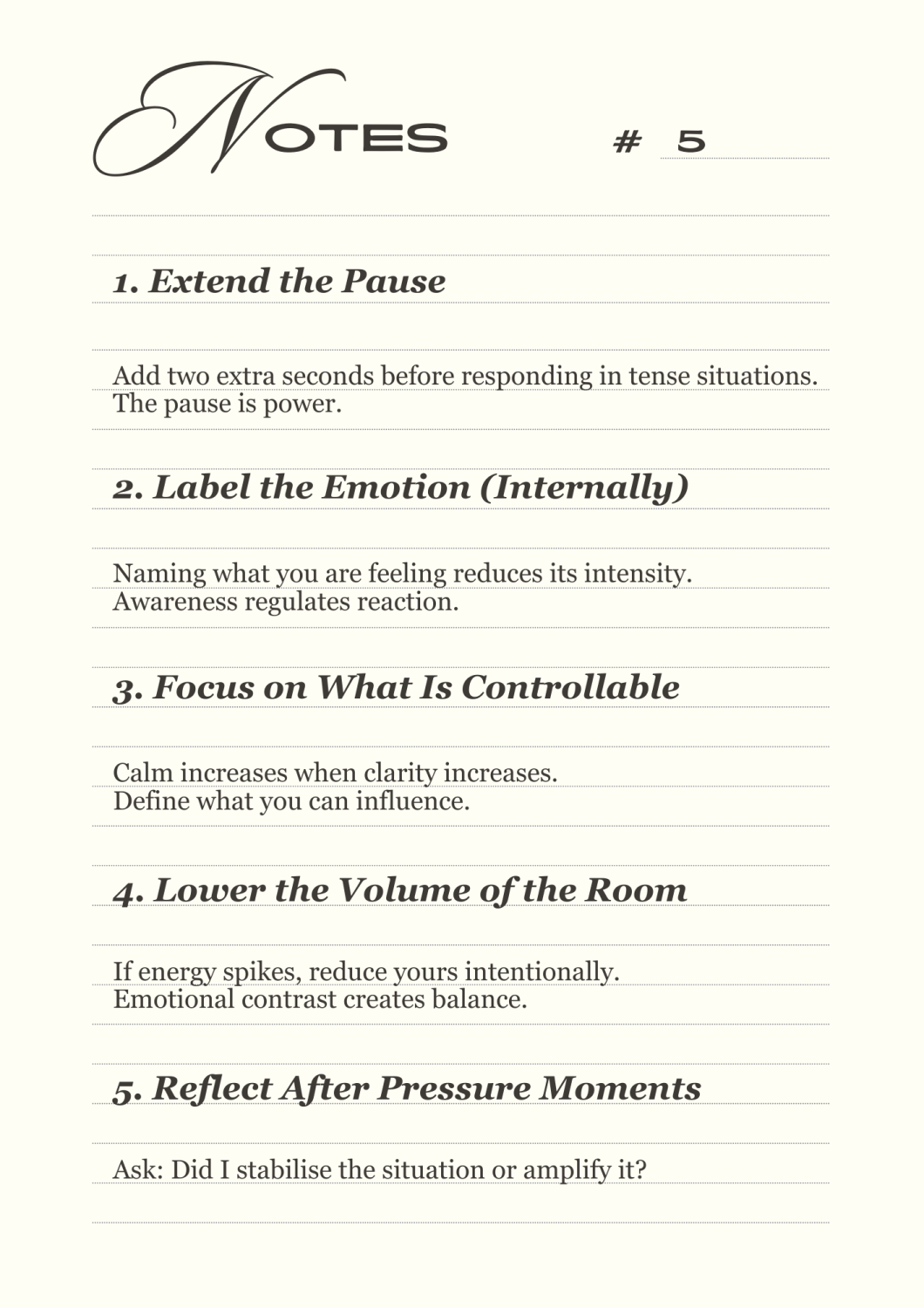
Like any other skill, Calm compounds with practice!
Why Calm Is a Career Multiplier
People trust calm leaders.
They are invited into bigger decisions. Given larger responsibilities. Relied upon during uncertainty.
Not because they speak the loudest. But because they steady the environment.
In a volatile world, calm has become the new credibility.
This and other essential skills are covered in Next-Level Skills — the book.
Learn more about the Book →A Reflection for This Month
Think about your last high-pressure moment.
Reflection Questions
Some Final Thoughts...
Calm is not the absence of intensity. It's in fact completely opposite - It is the presence of control.
And in leadership, that changes everything.
Agree?
Until Next Month, Lead steadily!
Abhishek
Founder & CEO, LegiQ | Building Intelligent Edge Hardware
How do you model emotional stability for your team?
How do you separate urgency from importance?
When pressure rises, what usually shifts first - your tone, your thinking, or your decisions?
What triggers most challenge your calm?
What habits help you stay composed during uncertainty?
What does “calm authority” look like in action?
What daily practice could strengthen your calm leadership muscle?
Do your teams experience you as steady or reactive?
How do you reset yourself in the middle of a tense conversation?
Can you think clearly when emotions run high - or do you need space first?
Gift the Book
- ✓A colleague stepping into leadership.
- ✓A team member navigating change.
- ✓A friend looking to take their next step professionally.
This and other essential skills are covered in Next-Level Skills — the book.
Learn more about the Book →This edition is reserved for supporters
Subscribe free, then unlock every past edition with just 1 successful referral.
Subscribe Free →Enjoyed this edition?
Get the next one in your inbox — first week of every month.