Leading through Uncertainty
Clarity, When There Is None
Welcome back to another edition of Next-Level Skills. Each edition, we explore the human and leadership capabilities that help us navigate work and life more effectively. Skills that move beyond theory and into practical application.
A warm welcome to everyone who has joined our community since the last edition. Whether you've been with us since the beginning or have recently discovered the newsletter or the book, thank you for being part of this journey.
Uncertainty is no longer an exception. It is the environment.
Markets shift. Priorities change. Plans evolve. Information is incomplete. Timelines move. Expectations blur. And in the middle of it all, leadership is still expected.
Not when things are clear. But precisely when they are not. That is the real test.
The Illusion of Certainty
Most of us were trained to walk in with answers.
Have the plan. Own the room. Know where you're going.
But here's the thing :
There are moments where the data runs out. Where the outcome is genuinely unclear. Where the path is still being figured out in real time. And in those moments, forcing confidence doesn't make people trust you more. It makes them trust you less.
Because they can feel it. The rehearsed certainty. The performance of having it together.
What they're actually looking for is something harder to fake and far more powerful.
What People Look for in Uncertainty
When things feel unclear, people look beyond strategy.
They look at the leader.
Not just for answers, but for signals.
Are they calm? Are they grounded? Are they honest about what they know and what they don’t? Are they moving forward, even without perfect clarity?
Uncertainty amplifies behaviour. It exposes leadership.
Leadership is the capacity to translate vision into reality.
— Warren Buffet
And in uncertainty, that translation starts with presence, not precision.
A Moment That Redefined Leadership for Me
Midway through one of the most intense projects I've worked on, everything shifted at once.
Requirements changed overnight. Stakeholders were pulling the team in different directions. The timeline was shrinking and the pressure to just say something - to step up, take charge, give people a direction - was immense.
Every instinct said: fill the silence. Project confidence. Figure it out later.
But, we didn't.
We stopped. We named what we didn't know. We laid out what we did. And instead of pretending we had the whole map, we agreed on the next step - just one - and moved.
The energy shifted in the room after that. Not because we had answers. But because we were honest about where we stood, and clear about where we were going next.
The team didn't need us to have everything figured out. They needed to feel forward motion - even if it was just one step at a time.
That day, I finally understood it.
Leading Without All the Answers
Uncertainty does not remove the need for leadership. It in fact, redefines it completely.
Leadership in uncertainty looks like:
- →Communicating direction without overpromising
- →Making decisions with incomplete information
- →Creating movement without perfect plans
- →Holding space for questions without defensiveness
Five Practices for Leading Through Uncertainty
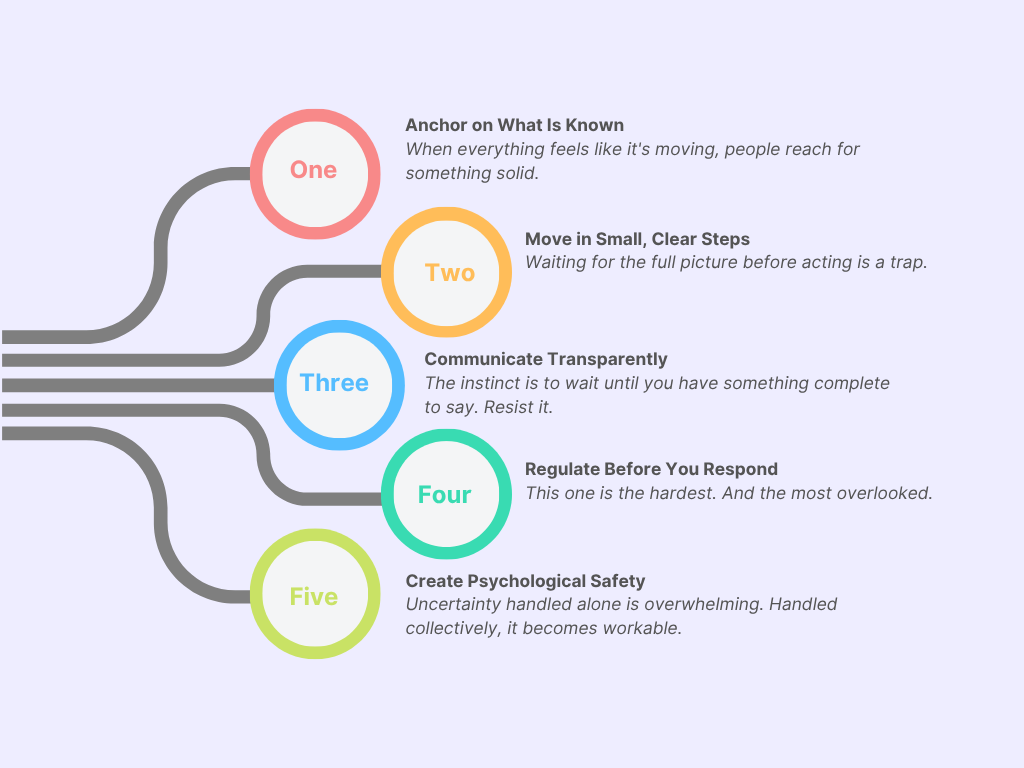
- 1Pro Tip: Anchor on What Is KnownWhen everything feels like it's moving, people reach for something solid. Your job, as a leader, is to give them that. Even in the most uncertain situations, something remains stable - a confirmed budget, an agreed outcome, a non-negotiable deadline. Find it. Name it clearly. Say it out loud. That anchor isn't just informational. It's psychological. It tells people: we are not completely adrift. And from that foundation, decisions can be made, conversations can happen, and momentum can begin.
- 2Pro Tip: Move in Small, Clear StepsWaiting for the full picture before acting is a trap. The full picture rarely arrives on schedule. And while you're waiting, the team is watching and wondering. Instead, identify the next right move. Not the whole plan. Just the next step. Something concrete, achievable, and directionally sound. Progress, even sightly incremental progress, does something certainty cannot. It builds confidence through evidence. Each small step forward becomes proof that moving through uncertainty is possible.
- 3Pro Tip: Communicate TransparentlyThe instinct is to wait until you have something complete to say. Resist it. People don't need polished answers. They just need the honest ones. Tell them what you know. Tell them what's still evolving. Tell them what happens next. That structure (known, evolving, next) does more for trust than any amount of projected confidence. Because clarity is not about having all the answers. It's about making sure no one is left guessing alone.
- 4Pro Tip: Regulate Before You RespondThis one is the hardest. And the most overlooked. Your emotional state doesn't stay with you - it spreads. The way you walk into a room, the tension in your voice, the speed at which you respond under pressure, your team reads all of it. Before you speak, pause. Breathe. Centre yourself. Not because the situation isn't serious. But because how you show up in that moment sets the tone for how everyone else does too. Calm is contagious. So is panic. Choose deliberately.
- 5Pro Tip: Create Psychological SafetyUncertainty handled alone is overwhelming. Handled collectively, it becomes workable. But people will only contribute, their questions, their concerns, their ideas, if they believe it's safe to do so. That safety doesn't happen automatically. It has to be built, deliberately, through how you respond when someone raises a doubt, flags a risk, or pushes back on a direction. When people feel heard rather than managed, they stop waiting for you to have all the answers. They start helping find them. That's when a team stops being a group of individuals and starts moving like one. To know more of this important topic, I'd suggest to follow Peter Brace PhD, Author and International Keynote Speaker on Psychological Safety and Psychosocial Risks.
Why This Skill Matters More Than Ever
We are operating in a world where change is continuous. Plans are no longer fixed. Roles are evolving. Expectations are shifting faster than before.
In this environment, the most effective leaders are not the ones with perfect foresight.
They are the ones who can:
Stay calm. Think clearly. Communicate honestly. Act decisively
Even when the path is not fully visible.
That is where trust is built.
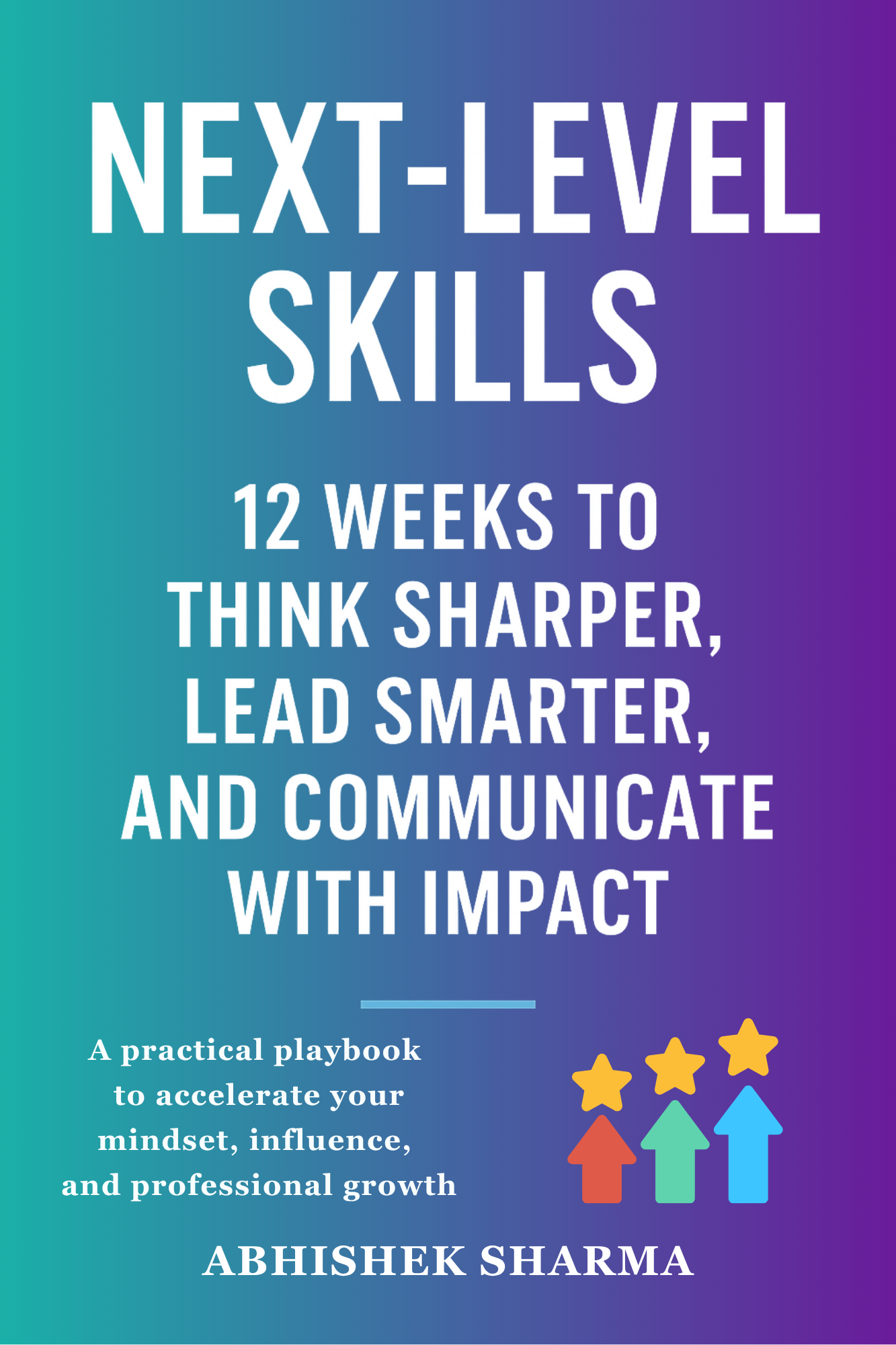
This and other essential skills are covered in Next-Level Skills — the book.
Learn more about the Book →A Reflection for This Month
Think about a current situation where clarity is limited.
Reflection Questions
Some Final Thoughts...
Uncertainty does not weaken leadership. It reveals it.
It strips away preparation and exposes presence. It tests not just what we know, but how we show up.
The greatest danger in times of turbulence is not the turbulence. It is to act with yesterday’s logic.
— Peter Drucker
Leading through uncertainty requires a different approach.
Less control. More clarity.
Less perfection. More progress.
Until Next Month, stay steady.
Abhishek
Founder & CEO, LegiQ | Building Intelligent Edge Hardware
What would leading with clarity instead of certainty look like in your current role?
How do you balance speed and thoughtfulness when decisions need to be made quickly?
What is one situation right now where you could take the next small step instead of waiting?
When was the last time uncertainty actually led to a better outcome for you?
What helps you stay calm when everything around you feels unclear?
How do you currently communicate when you don’t have all the answers?
What signals does your behaviour send to others during uncertain moments?
How can you create more psychological safety for your team during uncertain times?
How comfortable are you admitting “I don’t know” in a professional setting?
When faced with uncertainty, do you tend to wait for clarity or create it through action?
Buy the Book
- ✓Learn the full Next-Level Skills framework.
- ✓Build clarity, influence, and decision-making strength.
- ✓Accelerate your personal and professional growth.
This and other essential skills are covered in Next-Level Skills — the book.
Learn more about the Book →This edition is reserved for supporters
Subscribe free, then unlock every past edition with just 1 successful referral.
Subscribe Free →Enjoyed this edition?
Get the next one in your inbox — first week of every month.