The Power of the Pause
Why the Best Response Is Sometimes No Response
Welcome back to another edition of Next-Level Skills. Each edition, we explore the human and leadership capabilities that help us navigate work and life more effectively. Skills that move beyond theory and into practical application.
A warm welcome to everyone who has joined our community since the last edition. Whether you've been with us since the beginning or have recently discovered the newsletter or the book, thank you for being part of this journey.
This month, we're exploring a skill that rarely gets credit, because by definition, it leaves nothing visible behind:
Because we often, (almost always!) tend to measure leadership by what people do. But, if we were to look at many historic instances, some of the most consequential leadership moments were defined by what someone chose not to do.
The Email I Never Sent
A few years ago, I received an email that felt, at the time, like a direct shot at work I'd put my blood and sweat into. I felt really humiliated.
I immediately opened a blank reply and wrote three sharp, well-reasoned paragraphs within about ten minutes. Every sentence felt justified to me and I was ready to hit send and fire my response away!
While almost no one would have blamed me for sending the "exact" version of the email.
I didn't send it. I closed the laptop instead.
Not because I'd changed my mind about the content. I hadn't, not yet. But because something told me the version of me writing at that speed, with that heat, wasn't the version I wanted representing me.
I read the draft again the next morning. It was accurate. It was also unnecessary, and in two places, unkind in a way I hadn't noticed the night before. I rewrote it in four sentences.
The relationship survived. The original three paragraphs never saw the daylight.
And that is why the pause deserves far more respect than it usually gets, especially in a culture that treats speed as the same thing as decisiveness.
Why Silence Feels Like Weakness, But Rarely Is
The pause is not indecision.
It is choosing not to let urgency make the decision for you.
The challenge is that silence often feels uncomfortable in the moment, for you and for whoever is waiting on it.
A fast reply feels responsive.
An immediate reaction feels like leadership.
And so, without quite meaning to, we start equating speed with strength, even when the fastest response is rarely the wisest one.
Every hasty reply sent to prove you're on top of things, every reaction fired off before the full picture arrived, these rarely look like mistakes in the moment. They usually only look like mistakes in hindsight.
The instinct is to treat a pause as something that happens to you, a gap you fall into. In reality, it is something you choose, deliberately, and it gets easier to choose the more you practice it.
The Myth That No Response Means No Leadership
Many people assume that staying quiet in a tense moment signals weakness, that a leader who doesn't immediately weigh in has somehow abdicated the room.
What actually signals strength is restraint, applied on purpose.
Saying nothing doesn't mean having nothing to say.
It often means having enough self-control to wait until what you say will actually help.
And it is that restraint, far more than any quick comeback, that tends to earn the most lasting respect in a room.
"Silence is a source of great strength."
— Lao Tzu
The goal should not be to always have the fastest response. It should be to make sure every response you give is one you still agree with the next morning.
What Leaders Who Master the Pause Do Differently
Across tense conversations and high-stakes decisions, leaders who use the pause well tend to do several things consistently.
- →They separate the urge to respond from the need to respond.
- →They let a draft sit before sending it, especially when it was written while frustrated.
- →They ask whether staying quiet right now actually costs them anything, or just feels like it does.
- →And they treat silence as a genuine option, not a failure to have one.
In other words, they make themselves unrushed in exactly the moments everyone else is reactive.
That approach doesn't mean withdrawing from hard conversations. But it dramatically changes the quality of what gets said, and what gets left unsaid, once the moment has passed.
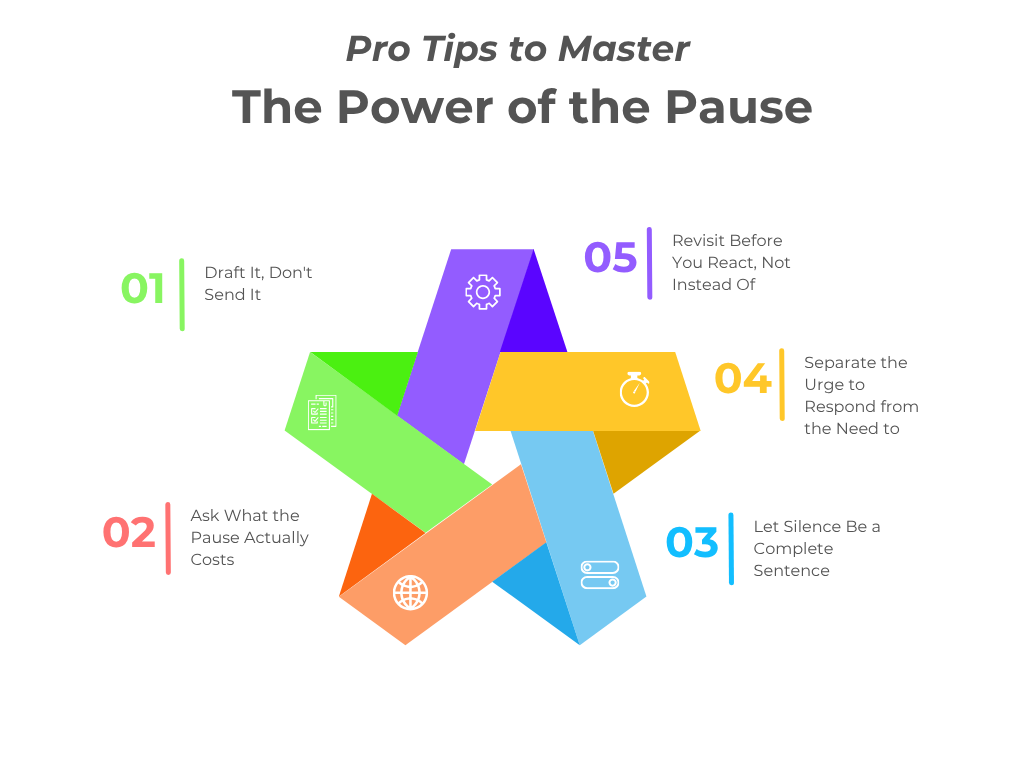
Pro Tip: Draft It, Don't Send It
When something provokes you, write the response in full, then close it without sending. Getting it out of your system matters more than anyone reading it does.
Almost everything written in the first ten minutes of frustration reads differently twelve hours later. Let that gap do its work before you let anyone else see it.
Pro Tip: Ask What the Pause Actually Costs
Before rushing to respond, ask plainly: "What do I actually lose by waiting an hour, or a day?" Most of the time, the honest answer is almost nothing.
The pressure to respond instantly is usually self-imposed, not externally required. Naming that out loud often dissolves most of the urgency.
Pro Tip: Let Silence Be a Complete Sentence
Not every comment, criticism, or provocation requires a reply. Some of the strongest moves in a tense exchange are the ones where nothing visibly happens at all.
You don't owe everyone an immediate reaction, even when they're clearly expecting one. Choosing not to engage is still a choice, and often the wiser one.
Pro Tip: Separate the Urge to Respond from the Need to
The urge to respond is emotional and immediate. The need to respond is practical and can almost always wait longer than it feels like it can.
Learn to notice which one is driving you before you act. If it's only the urge, that's usually your cue to wait.
Pro Tip: Revisit Before You React, Not Instead Of
A pause isn't meant to be permanent. It's meant to buy you the clarity to respond well, not an excuse to avoid responding at all.
Set yourself a clear point to return to it, later that day, the next morning, so the pause stays a tool, not an escape.
Why This Skill Matters More Than Ever
Today's always-on environment gives us more opportunities than ever to respond instantly, and fewer natural reasons to pause before we do.
- →Notifications create pressure to reply within minutes, whether or not the moment actually calls for it.
- →Public platforms turn private frustrations into permanent, visible records within seconds.
- →And the speed of modern communication makes a thoughtful pause feel, incorrectly, like falling behind.
In this environment, the ability to deliberately withhold a response has become one of the rarest, and most quietly powerful, leadership skills a person can build.
Because almost anyone can react quickly. It's the pause that determines whether what finally gets said actually helps, or simply adds to what needs repairing later.
That is where real judgment, the kind people come to rely on, is built.
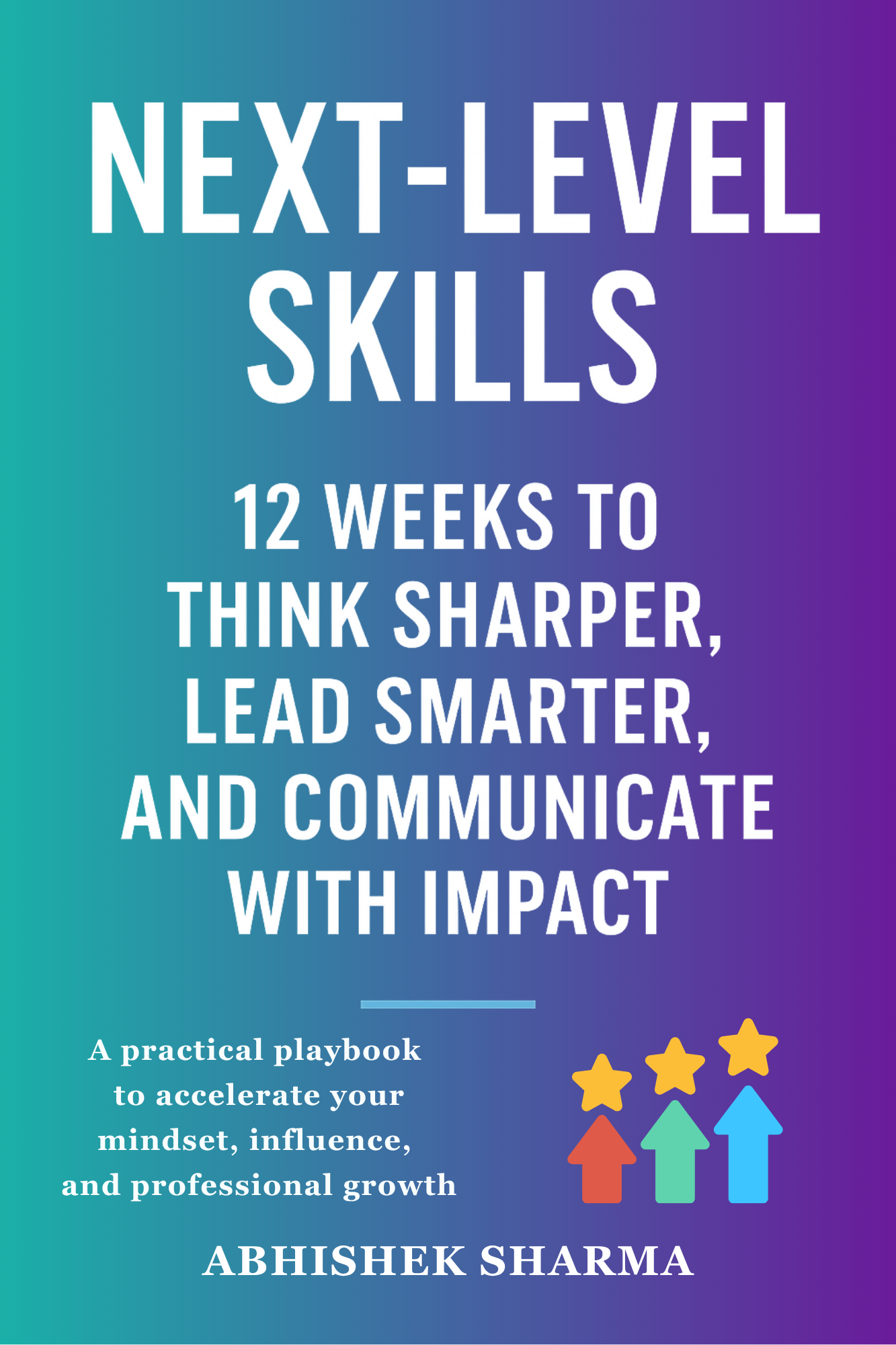
This and other essential skills are covered in Next-Level Skills — the book.
Learn more about the Book →A Reflection for This Month
Think about the last time you responded to something quickly, and later wished you'd waited.
Reflection Questions
The answers to those questions often reveal more about our leadership than any single achievement does.
Some Final Thoughts...
The pause rarely feels impressive while you're in it. It only reveals its value afterward, in everything it quietly prevented.
The leaders we trust most under pressure aren't the ones with the fastest reply.
They are the ones who've learned that restraint, chosen deliberately, is often the more powerful move.
"In that space is our power to choose our response."
— Viktor Frankl
That space, protected on purpose instead of rushed through, is what the pause really is. And ultimately, it is what makes sure your response is actually yours, and not just your urgency speaking for you.
Until Next Month, let silence do some of the work.
Abhishek
Founder & CEO, LegiQ | Building Intelligent Edge Hardware
Buy the Book
- ✓Learn the full Next-Level Skills framework.
- ✓Build clarity, influence, and decision-making strength.
- ✓Accelerate your personal and professional growth.
This and other essential skills are covered in Next-Level Skills — the book.
Learn more about the Book →Enjoyed this edition?
Get the next one in your inbox — first week of every month.