Collaboration
Collaboration: Unlocking the Power of Teamwork
Welcome back to another edition of Next-Level Skills. Each edition, we explore the human and leadership capabilities that help us navigate work and life more effectively. Skills that move beyond theory and into practical application.
A warm welcome to everyone who has joined our community since the last edition. Whether you've been with us since the beginning or have recently discovered the newsletter or the book, thank you for being part of this journey.
This week, we delve into Collaboration — a cornerstone of success in today’s interconnected workplaces. Effective collaboration goes beyond working together — it’s about blending diverse strengths, fostering innovation, and achieving shared goals.
Let’s begin with a quick story that highlighted me, the transformative potential of true collaboration.
When Collaboration Changed the Game
A few years ago, I was part of a multi-department project team tasked with launching a new product. While everyone shared enthusiasm for the initiative, our first few meetings were chaotic. Each department had its own priorities, and discussions often stalled as we struggled to align objectives.
After one particularly unproductive meeting, I realised we needed a different approach. At the next session, I suggested dedicating the first half to understanding each department’s goals and challenges. This created a sense of mutual respect and helped us identify common ground. From there, we formed subgroups based on complementary strengths, giving each team clear responsibilities.
The results were remarkable.
Not only did the project exceed expectations, but the trust and camaraderie we built carried over to future collaborations.
What is Collaboration?
Collaboration is the process of individuals or groups working together to achieve a shared goal by leveraging collective knowledge, skills, and resources. It thrives on communication, trust, and adaptability, enabling teams to achieve results that far exceed what any individual could accomplish alone.
Alone we can do so little; together we can do so much.
— Helen Keller
Why Collaboration Matters
Collaboration is not just a nice-to-have — it’s a must-have for thriving in complex, fast-paced environments. Here’s why it’s essential, it —
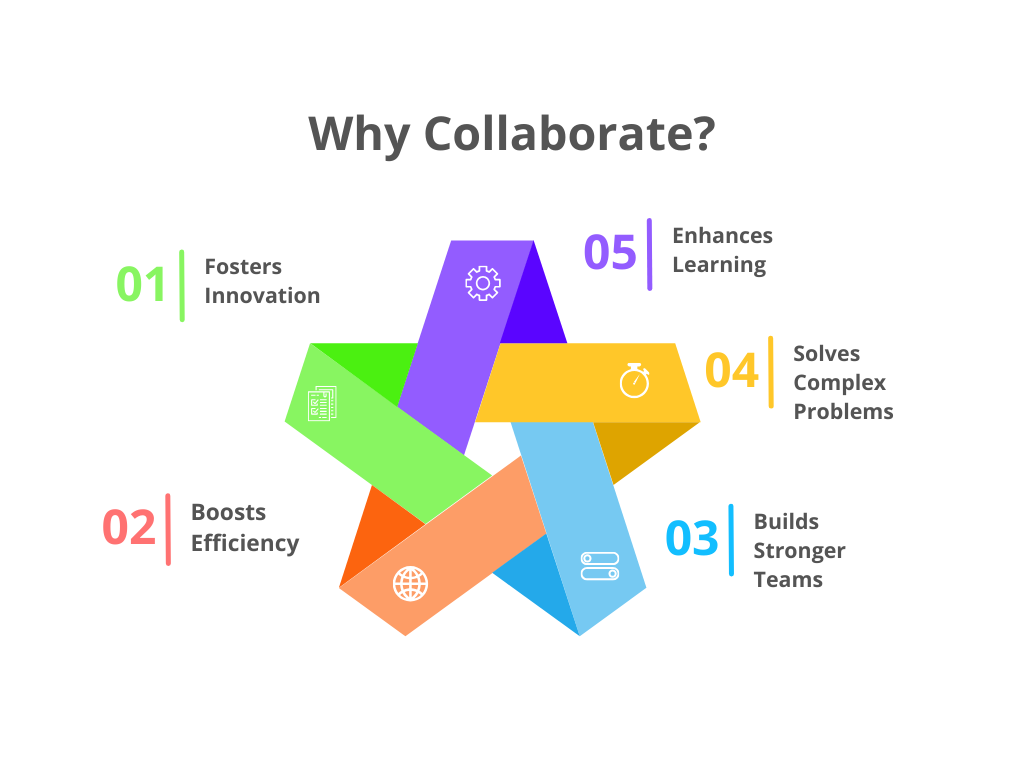
- 1Fosters InnovationCollaboration brings diverse perspectives together, often leading to creative and innovative solutions.
- 2Boosts EfficiencyBy dividing tasks based on strengths, collaboration reduces redundancies and improves productivity.
- 3Builds Stronger TeamsWorking collaboratively strengthens relationships, trust, and mutual respect within teams.
- 4Solves Complex ProblemsTackling multifaceted challenges becomes easier when multiple perspectives and expertise are involved.
- 5Enhances LearningCollaboration allows us to learn from each other, broadening our skill sets and knowledge base.
Principles of Effective Collaboration
Collaboration thrives on a foundation of shared understanding and respect. By aligning our efforts with key principles, we can build a culture where teamwork flourishes. These principles serve as the guiding framework for navigating challenges, fostering creativity, and achieving common goals.
Let’s break down what makes collaboration truly effective.
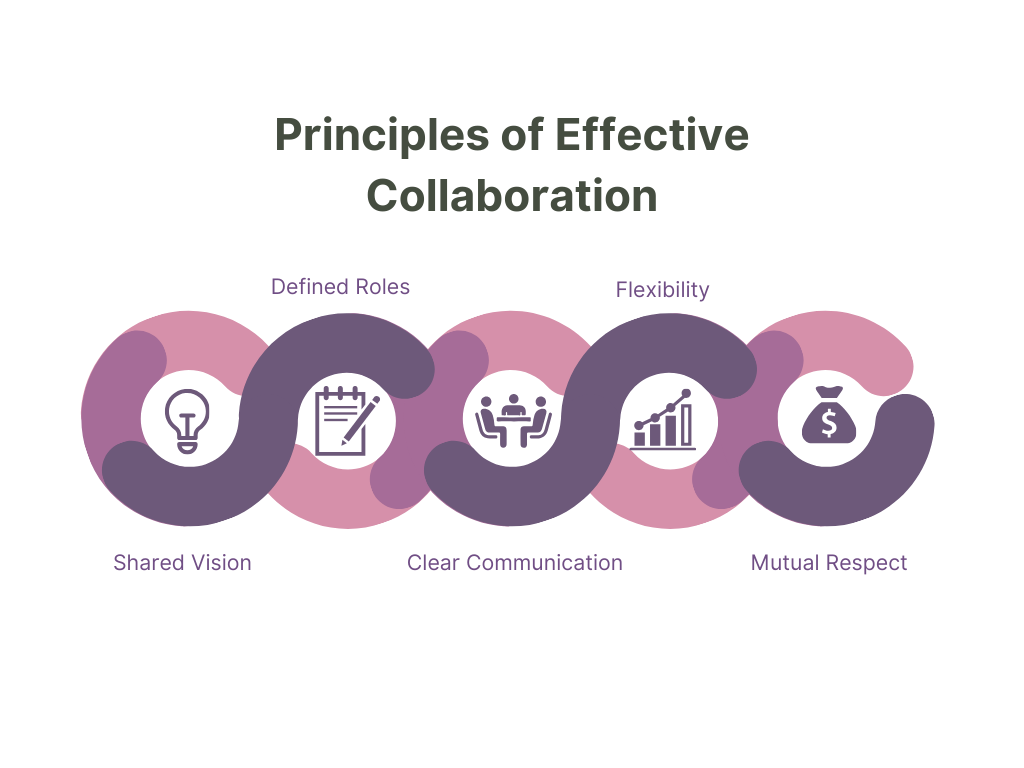
- 11. Clear CommunicationSet expectations and communicate openly to avoid misunderstandings.
- 22. Defined RolesEnsure everyone knows their responsibilities to minimise overlap or gaps.
- 33. Mutual RespectValue every voice and contribution, fostering an inclusive environment.
- 44. Shared VisionAlign goals and objectives to ensure everyone is working towards the same outcome.
- 55. FlexibilityBe open to adapting plans and accommodating diverse perspectives.
These principles are not just theoretical — they are actionable guidelines that ensure collaboration remains meaningful and productive. When we embrace these principles, we create an environment where everyone feels valued and aligned. We create a strong foundation for collaboration.
Practical Tips for Fostering Collaboration
Effective collaboration doesn’t just happen — it requires intentional effort, clear communication, and a commitment to shared goals. By implementing practical strategies, we can create an environment where collaboration thrives, enabling us to harness the collective power of our teams.
Let’s explore actionable tips that help foster stronger, more productive partnerships.
Create Open Communication Channels
Establish clear and accessible communication platforms for seamless exchanges.
Pro Tip: Use tools like Slack or Microsoft Teams to encourage real-time updates, file sharing, and open discussions. Combine this with scheduled check-ins to ensure alignment.
Leverage Individual Strengths
Assign tasks based on each person’s strengths and expertise to maximise efficiency and engagement.
Pro Tip: If one team member excels at data analysis, let them handle metrics while another focuses on client-facing responsibilities. Recognising and utilising strengths boosts morale and productivity.
Define Goals and Milestones
Break down the overarching objective into smaller, clear milestones to track progress effectively.
Pro Tip: For a product launch, outline key stages such as design completion, prototype testing, and marketing rollout, assigning deadlines and owners for each.
Encourage Constructive Feedback
Foster an environment where feedback is seen as an opportunity for growth rather than criticism.
Pro Tip: Use the “Start, Stop, Continue” framework during team reviews: What should we start doing? What should we stop doing? What should we continue doing?
Celebrate Team Wins
Acknowledge achievements, big or small, to maintain motivation and reinforce a sense of shared accomplishment.
Pro Tip: After completing a major milestone, hold a quick team huddle or send a recognition email highlighting contributions from each member.
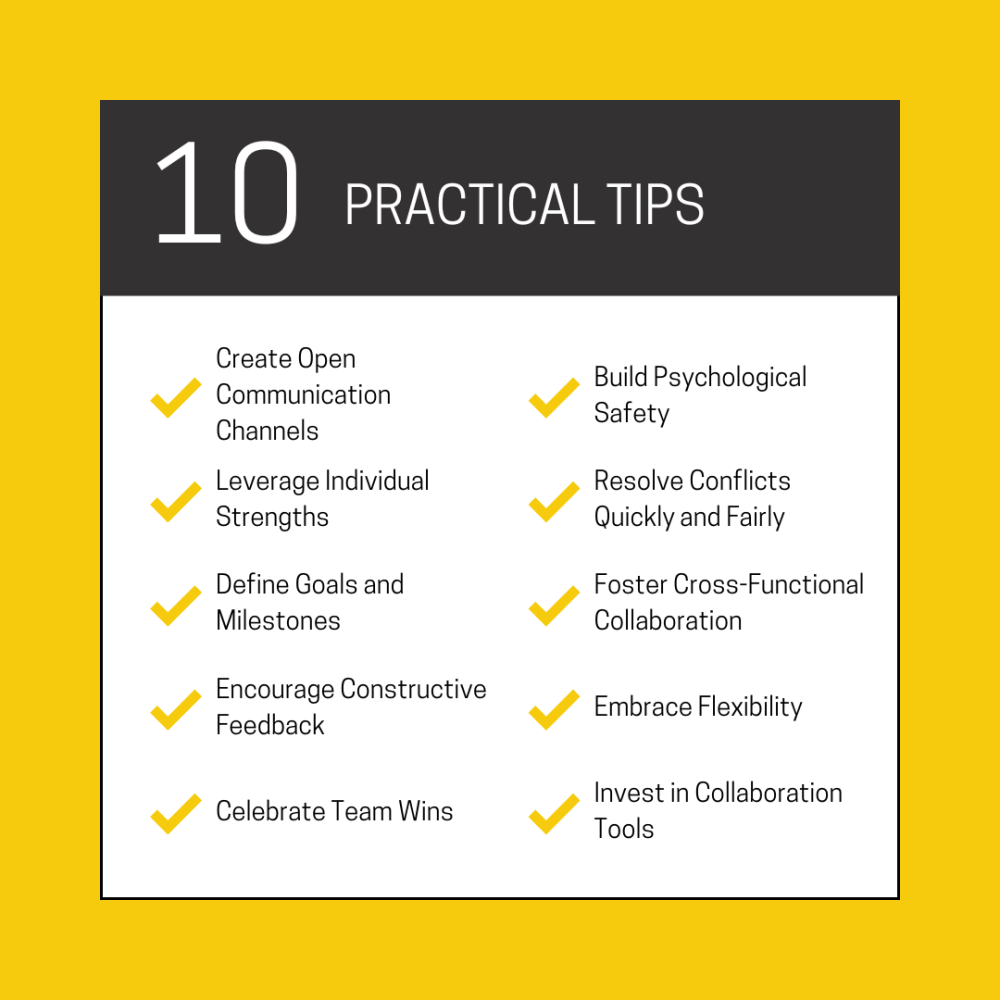
Build Psychological Safety
Create an atmosphere where team members feel safe sharing ideas without fear of judgement.
Pro Tip: Encourage brainstorming sessions where all ideas are welcomed, no matter how unconventional, and follow up by collectively evaluating their feasibility.
Resolve Conflicts Quickly and Fairly
Address disagreements promptly by focusing on solutions rather than assigning blame.
Pro Tip: If two team members have conflicting priorities, facilitate a discussion to find a compromise that aligns with the overall goal.
Foster Cross-Functional Collaboration
Encourage collaboration across departments to leverage diverse expertise and viewpoints.
Pro Tip: Pair marketing and product teams to create campaigns that resonate with technical capabilities and audience expectations.
Embrace Flexibility
Be open to adjusting plans when faced with new information or challenges.
Pro Tip: If a project plan isn’t yielding the desired results, reassess the strategy collectively and iterate accordingly.
Invest in Collaboration Tools
Use technology to streamline workflows and keep everyone aligned.
Pro Tip: Implement project management tools like Asana or Trello to visualise progress, assign tasks, and meet deadlines effectively.
By applying these tips, we can build teams that communicate effectively, respect individual strengths, and work seamlessly towards common objectives. When collaboration becomes second nature, the results can exceed even our highest expectations!
This and other essential skills are covered in Next-Level Skills — the book.
Learn more about the Book →A Challenge
Reflect on a recent project or task where collaboration played its role.
Ask yourself:
Reflection Questions
This week, focus on one of the practical tips — such as building psychological safety or leveraging strengths — and implement it in a current project or team interaction and record the benefits.
Some Final Thoughts...
Collaboration is more than just working together — it’s about building trust, valuing differences, and aligning towards a shared vision. When done right, it becomes a powerful tool for innovation, efficiency, and growth.
Teamwork is the ability to work together towards a common vision. It is the fuel that allows common people to attain uncommon results.
— Andrew Carnegie
By fostering collaboration, we unlock the potential of individuals and teams, achieving results far greater than we could alone.
Thank you for joining us on this journey. Let’s continue to share, learn, and grow together.
Until Next Time,
Abhishek
Founder & CEO, LegiQ | Building Intelligent Edge Hardware
What role does trust play in fostering collaboration, and how do we build it?
How do we handle conflicts in a way that strengthens rather than weakens collaboration?
What’s one area of collaboration that we find challenging, and how can we improve it?
Can you recall a project or an instance where collaboration led to an unexpected breakthrough? What made it successful?
What strategies do we use to ensure everyone’s voice is heard during collaboration?
How can we encourage cross-departmental collaboration in organisations?
What’s one tool or process that has significantly improved collaboration for our teams?
What’s the most valuable lesson you’ve learned from a collaborative project?
How do we balance individual autonomy with collective teamwork?
How do we adapt collaborative practices in hybrid or remote work environments?
Buy the Book
- ✓Learn the full Next-Level Skills framework.
- ✓Build clarity, influence, and decision-making strength.
- ✓Accelerate your personal and professional growth.
This and other essential skills are covered in Next-Level Skills — the book.
Learn more about the Book →This edition is reserved for supporters
Subscribe free, then unlock every past edition with just 1 successful referral.
Subscribe Free →Enjoyed this edition?
Get the next one in your inbox — first week of every month.